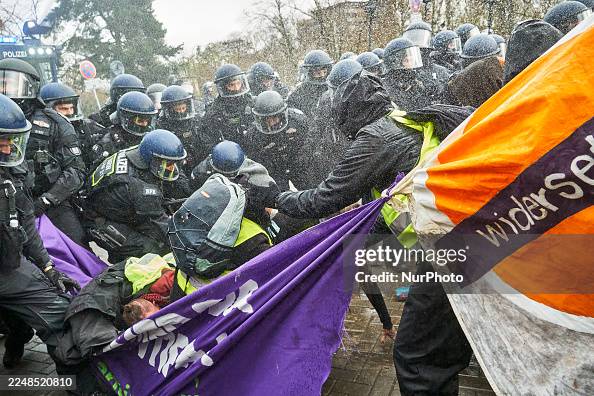
On 29.11.25, many left, Antifa and solidarity groups followed the call by Widersetzen to protest the formation of the AfD youth in Gießen. The demonstration was met with police violence. This article argues that the struggle against fascism is necessarily global and international – otherwise it is doomed to fail. It aims to strengthen the connections between our different struggles and make visible that they belong to the same fight.
“They tolerated that Nazism before it was inflicted on them… because, until then, it had been applied only to non-European peoples.”
Aimé Césaire, Discourse on Colonialism
Fascism cannot be separated from colonialism, racism, or capitalism. In Germany, fascism used the same tools first deployed in Namibia. The genocide of the Herero and Nama is the model that the Holocaust followed. Genocide was the final step in a fascist project that began with the brownshirts, who terrorized any opposition as well as minorities and Jews.
We see the same logic at work today:
In Sudan, where the RSF terrorizes civilians and seizes their homes, land, and property, and has built an entrepreneurial empire on gold and oil smuggling and human trafficking.
In the USA, where ICE hunts, cages, and deports migrants, forcing people into precarity and making super-exploitation and low wages easier to enforce.
In the West Bank, where settlers attack, expel, and dispossess Palestinians, trying to replace them with Jewish settlers and turn Palestinian land and homes into Jewish property and enterprise.
Seeing the common ground between these movements and the Nazi brownshirts and Nazi state makes the pattern clear:
First define a group as “the other.”
Then strip them of rights.
Then take their homes, wages, land, and future.
Fascists start by liquidating the assets and lives of the weakest and most exposed: the people on the fringes, the “not integrated,” migrants, racialized people, the poor, queer and trans people, disabled people, women and gender-nonconforming people.
Instead of confronting the capitalist class, where wealth is concentrated, fascism offers capitalism its ugliest compromise: in times of crisis it reorganizes the system through racist violence – a dog-eat-dog redistribution from below that strips the most oppressed of their homes, wages, land, and lives while the rich remain untouched.
Being antifascist means committing to fight these movements where they hit first: at the margins, against those made vulnerable by racism, colonialism, and poverty.
In Germany, state and police violence has systematically targeted Black people and people of color.
In the last two years, the Palestine movement has faced bans, criminalization, and police attacks on an unprecedented scale.
The same methods are now used against antifascists and left movements.
Our struggles against racism, against Zionism, against police violence, and against fascism are all connected.
“Injustice anywhere is a threat to justice everywhere.”
Martin Luther King Jr., Letter from Birmingham Jail
We have to fight for liberation for all, not for some.
Fighting the AfD cannot be separated from fighting the global systems it feeds on: borders, deportations, prisons, apartheid, war, surveillance, and exploitation.
Solidarity is not just a word. It is action and long-term commitment. It is a struggle – not a game of whack-a-mole, chasing fascists wherever they pop up, but a fight to confront the conditions that allow them to emerge in the first place.
Instead our solidarity has to be the opposite of fascism and colonialism: a real commitment to global justice, made concrete through the redistribution of wealth and power—away from corporations and empires, toward communities, workers, and all who are pushed to the margins.
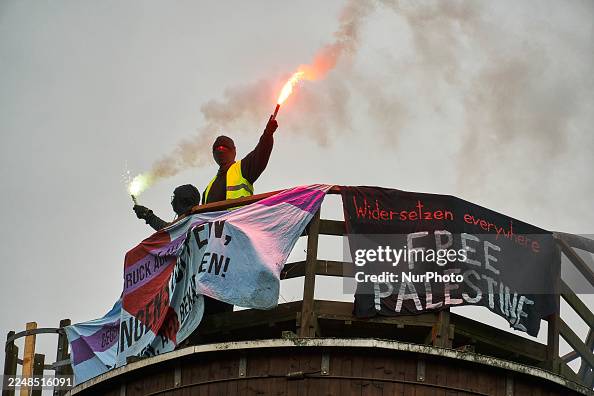
A protester stands on a construction structure holding flares in Giessen, Germany, on November 29, 2025, during a nationwide day of mobilization against the relaunch of the youth organization of the far-right AfD (Alternative für Deutschland). The alliance widersetzen had called for the mobilization. More than 200 buses and over 50,000 protesters from across Germany arrived in Giessen to oppose and prevent the relaunch. Police responded with a major deployment and used a level of force not seen in the leftist scene outside of Palestine-solidarity protests. (Photo by Tonny Linke/NurPhoto via Getty Images)
Robin D.G. Kelley — “The Black Radical Tradition Against Fascism and Genocide: The Long Durée” (UMass Amherst, April 3, 2025)
We witnessed a live streamed genocide in Gaza. We saw the bodies of children hanging on fences and babies shot in the head. Parents losing the soul of their souls. We must ask ourselves how this can be possible. How can this kind of violence exist? Let alone be justified?
It happens with the full consent of our politicians. They are not misinformed. These politicians know better than you and me—better than all of us—the extent of the suffering and destruction in Palestine. And they know something else:
Normalizing the violence in Palestine is necessary in order to import this violence here.
These same politicians in Germany and America also know the role Palantir plays in the genocide. Palantir also openly admitted that its technology kills people in Gaza:
“Mostly terrorists,” as Palantir’s CEO admitted.
But who is a terrorist and who is not? Who deserves to live and who does not? Over 70,000 people killed. Mostly women and children. Genocide.
The same platform is used by ICE to decide who belongs and who does not. Who stays and who is removed.
Over 2 million people deported in the first 250 days of the Trump administration.
We have to ask: why did the Baden-Württemberg state pay 25 million euros to bring Palantir into the police? For Palantir’s surveillance and AI platform?
To help decide who is a “problem in the Stadtbild”?
Who is a “dangerous migrant”?
Who is an “antisemite”?
The reason we do not feel safe in Germany is because we know:
The violence in Gaza, in Sudan, in Congo is what normalizes the violence here.
The fascists of today no longer wear brown shirts. They wear blue (police) uniforms.
Palantir sits at the intersection of our struggles: against surveillance, against capitalism, against Zionism, against racism, against police violence and against deportations.
Alone, we cannot do much against these systems of oppression—but together we have a chance. As long as borders exist, our freedom here is a privilege.
From Gaza to Sudan. From Congo to Ecuador. From Brazil to the West Bank.
For justice.
For Lorenz, for Rahma, for Nelson.
For Hanau. For Solingen.
Get organized. On 13th december we are planning demonstrations throughout Baden-Württemberg against Palantir.
Die für eine der Solidarität verpflichteten Bewegung teilweise unerträgliche Kritik an unseren Kolleginnen von der Histadrut auch in gewerkschaftlichen Bünden verurteilen wir scharf. Nirgendwo anders werden Gewerkschaften mit dem Handeln ihrer Regierung gleichgesetzt und dafür verantwortlich gemacht. Die Histadrut steht immer wieder an der Spitze von Protesten gegen die israelische Regierung und setzt sich für ein friedliches Miteinander und den Austausch zwischen allen Beschäftigten ein.
In English:
We sharply condemn the at times unbearable criticism of our colleagues from the Histadrut, even within trade union federations, which claim to be committed to solidarity. Nowhere else are trade unions equated with the actions of their government and held responsible for them. The Histadrut has repeatedly been at the forefront of protests against the Israeli government and advocates for peaceful coexistence and exchange among all workers.
Taking a step back: why is the Histadrut subject to criticism at all? This article addresses that question by examining the Histadrut’s role, practices, political positioning, and its role in Israeli the war machine. On this basis, it argues that criticism is not only well-founded but necessary. Moreover, if the DGB is genuinely committed to “peace in the Middle East,” it must fundamentally reassess—and ultimately sever—its partnership with the Histadrut.
Founded in December 1920, the Histadrut—the General Federation of Hebrew Workers in Palestine—was established to secure the economic foundations of the Zionist project. Its core mission was not simply to organize workers, but to create and protect a Jewish labor force by excluding Palestinian Arab labor from key sectors of the economy. Through the doctrine of avodah ivrit (“Hebrew labor”), the Histadrut turned labor organization into a mechanism of colonization, linking employment to national belonging and transforming the workplace into a frontier of settlement.
From the outset, the Histadrut was both a union and an employer, owning enterprises, land, and industries that advanced Zionist colonization. Its companies—most prominently Solel Boneh—constructed roads, military outposts, and settlements, embedding the federation in the material infrastructure of the emerging Jewish state. As a central pillar of the Yishuv’s economic system, the Histadrut coordinated with the Jewish Agency and other state-building organs to exclude Palestinian workers, dismantle mixed unions, and monopolize employment through Jewish-only cooperatives and hiring halls.
After 1948, the Histadrut’s dual role as labor federation and development agency deepened. It became one of Israel’s largest employers, controlling major industrial, construction, and financial firms under its holding company Hevrat HaOvdim. These enterprises built the new state’s infrastructure while entrenching a racially segmented labor market that privileged Jewish citizens and relegated Palestinians—whether citizens of Israel or residents of the occupied territories—to precarious, low-wage positions outside collective representation.
By 1967, this institutional model had merged seamlessly with Israel’s occupation regime, subordinating Palestinian labor to Israeli regulatory power. Histadrut-affiliated firms such as Solel Boneh and Bank Yahav extended their activities into settlements in the West Bank and annexed East Jerusalem, while Palestinian workers in these same areas remained unrepresented. The federation’s continued integration with the settlement economy made it a direct participant in the consolidation of occupation.
The Military Role of the Histadrut
The Histadrut anchors organized labor inside Israel’s military-industrial complex, chiefly through its Metal, Electrical and High-Tech Workers Union, which represents employees at Israel Aerospace Industries (IAI), Rafael Advanced Defense Systems, and Elbit Systems. These firms produce core war-fighting systems—IAI’s missiles, UAVs, and C2 platforms; Rafael’s air and missile-defense and precision munitions; and Elbit’s electro-optics and battlefield electronics—central to Israel’s genocide in Gaza.
In this capacity, the Histadrut does not merely coexist with Israel’s war economy; it enables and sustains it, ensuring that labor power remains fully mobilized in the service of Israel’s continuing assault on Gaza.
The DGB has never been blind to the Histadrut’s historic role in the colonization of palestine, or its role in the . In its brochure “50 Jahre Partnerschaftsabkommen zwischen DGB und Histadrut”, it notes that “the Histadrut was practically a ‘state within the state.’” The federation’s support for Israel’s labor movement was not merely symbolic but consistently material—especially at pivotal moments. During the 1967 Six-Day War, for example, the DGB purchased an additional 3 million DM in development-aid bonds (Israel Bonds), publicly expressing confidence in Israel’s survival and democracy.
As the DGB Youth explicitly stated in Motion E011 “Boykotte boykottieren”, they branded BDS “anti-Israeli,” reaffirmed a two-state line, and distanced themselves from cultural, political, scientific, and economic boycotts of Israel. In practice, that stance delegitimized a key non-violent accountability tool and helped sideline BDS in labor forums. Coupled with defending the Histadrut while Palestinian workers remain excluded, and with German industry’s ongoing ties to Israeli firms (including war- and settlement-linked sectors), this posture shields the institutions underpinning Israeli apartheid—criticizing only its most visible violence while leaving its foundations intact.
Conclusion
What began as a gesture of postwar reconciliation has long since turned into complicity with a colonial project. The DGB’s partnership with the Histadrut — an institution that functions not as a vehicle of workers’ liberation but as a pillar of Zionist state power — embodies a deep contradiction at the heart of German labor internationalism. The Histadrut has never been a neutral trade union. From its founding, it has operated as an instrument of Jewish settlement, exclusion, and militarization. It is part of the political and economic structure that sustains Israel’s apartheid regime and its war economy.
By bargaining for the well-being of soldiers and reservists, by stabilizing Israeli civil society amid war, repression, and global outrage, and through its silence on the ongoing Gaza genocide, the Histadrut actively reinforces the occupation and the colonial order it depends upon. It negotiates not for the emancipation of all workers, but for the maintenance of privilege within an ethno-national state. To continue cooperation with such an institution — while Palestinian workers remain dispossessed, unrepresented, and exploited — is to abandon the principle of class solidarity in favor of nationalist loyalty.
It simply goes against the very concept of international worker solidarity to stand with a colonial labor federation that denies labor rights to those under occupation. It is not enough to condemn “extremism” or criticize “individual settlers” while ignoring the systemic role of Zionism and the Histadrut in perpetuating Palestinian exclusion and dispossession. The struggle for justice demands a break with this complicity.
If the DGB is serious about its proclaimed commitment to peace, it must act accordingly. That means ending its partnership with the Histadrut, supporting the Boycott, Divestment, and Sanctions (BDS) movement, and exerting pressure on German industry to sever all ties with Israel’s military-industrial complex and companies profiting from occupation and settlement. This is not simply a suggestion — it is an imperative of international worker solidarity.
To remain silent or neutral in the face of colonial and genocidal violence is to side with the oppressor. True solidarity lies with the Palestinian working class — those whose land, labor, and lives have been stolen, and who continue to resist against overwhelming power. Breaking with the Histadrut would not betray the principles of labor internationalism — it would restore them, aligning the German labor movement with the global struggle for justice, liberation, equality, and decolonization, from the Jordan to the Mediterranean.


 tadamun