In Freiburg’s Christmas market, it is easy to forget how violent our “normality” is organized. Lights, music, mulled wine – and at the same time: mobile vehicle barriers at every entrance, officially there to protect against “terror and rampage attacks”. These blocks are not just technical security. They are props for a story: the ever-present threat of “Islamic terror” outside, and a supposedly innocent, peaceful “inside” that must be defended.
This securitized “inside” is heavily staffed. The police are on duty at the market every day; at weekends they are reinforced by police from France and Switzerland. Riot police are planned, alongside private security and the city’s enforcement officers patrolling the stalls. Weapons and knives are formally banned. The message is clear: this is a controlled zone, guarded from “dangerous others”.
And because it is Freiburg, the whole thing is, of course, proudly advertised as running on “100% green energy” – a clean, sustainable Christmas. But that “green” electricity does not fall from the sky. It depends on batteries, cables and infrastructure built from raw materials ripped out of places like Congo: cobalt, copper, lithium. Meanwhile, genocide is being funded with our taxes and our labour. The cosy glow on the Münsterplatz is plugged directly into extractivism, poisoned rivers and exploited labour elsewhere.
Barriers, police, security and green branding together draw a line through the city. Inside the bright, fenced-off area: those who can afford five-euro Glühwein, welcome as customers. At the edges of the same square: people without housing, people in poverty, people racialised as “risky” – treated as security problems, not as neighbours. They literally sit at the periphery of the Christmas market, in the shadow of a celebration that is not meant for them.
Here, Merz’s talk of the Stadtbild becomes concrete. The Christmas market, with its consumer logic and “attractive cityscape”, is what is to be praised and protected. The people at its margins – the homeless, the poor, migrants – are what is to be admonished as a “problem for the cityscape”, something that spoils the image and should be removed.
Christmas sells itself as a time of charity and warmth, but it is organized as an exclusionary space. It separates those who “deserve” comfort from those who are allowed to exist only as a disturbance or threat. Even the supposed “way out” offered within this logic is individual: if you are poor, you are told to work harder, be entrepreneurial, maybe one day open your own stand. Poverty is framed as personal failure, not as the consequence of a system that needs winners and losers.
What is missing is any idea of solidarity that breaks with this logic altogether.
We can see another practice in Sudan.
KHARTOUM STATE, SUDAN – MARCH 17, 2025: A man distributes food at an Emergency Response Room communal kitchen in Bir Hamada, in Khartoum state. As a war between rival generals and their armed forces devastates Sudan, millions have been displaced and left without access to basic services like medical care, water and electricity. While those at the top fight for power, neighbourhood committees and Emergency Response Rooms build kitchens like this one to keep people alive and practice grassroots solidarity from below.
Under war, displacement, hunger and state collapse, neighbourhood resistance committees in Sudan have set up community kitchens to keep people alive. There are no cosy markets there, and no NGOs swooping in to “save” anyone. Human rights organisations and aid agencies are absent, or appear only on terms set by the same imperial states that help fuel the war – often providing just enough assistance to stabilise the situation and discourage migration towards Europe.
The community kitchens are something else entirely. They are not charity from above. They are self-organised survival: neighbours pooling what exists locally – a truck, a yard, a gas bottle, a field, cooking skills, time, labour – and turning it into shared infrastructure.
This is a radical reconceptualisation of resources. Instead of asking “Who has money?”, people ask “What do we have among us?” The return is not profit, but collective survival and strength. This model:
mobilises local, non-financial assets,
distributes food according to need,
and keeps control in the hands of those who use it.
Because decisions are made collectively, it resists hegemony and co-optation. It is explicitly political: a social space where popular power is practised daily, where people defend their ability to survive and shape their future, independent of external agendas. In Sudan, this is a matter of life and death.
In Freiburg, we live in extreme privilege by comparison. People freezing on the street here are not doing so because the city has no food, no space, no money. They are freezing because of political choices: property rights enforced more harshly than the right to housing; a city centre designed for consumption and tourism, not for need; ever-growing budgets for policing and “security” while social services are cut, privatised or buried in bureaucracy.
Exactly because our situation is so privileged, there is no excuse to maintain Christmas as an exclusionary spectacle ringed by barriers, police and guards – and then wash it green with “100% renewable” branding built on extraction elsewhere.
If we take the Sudanese community kitchens as a model, an autonomous, anti-capitalist Advent in Freiburg could mean:
Setting up solidarity kitchens at the edges of the Christmas market, serving hot food and tea to anyone who needs it – housed or unhoused, with or without papers – without pity, tests, or charity branding.
Pooling resources – kitchens, cars, storage spaces, skills, time, some money – to build common infrastructure: food, warm clothes, sleeping bags, power banks, information.
Treating these places not as neutral welfare, but as spaces to meet and organise: to talk about why people are homeless, policed and poor in one of the richest regions in the world – and how to change it.
The goal is not to make Christmas a bit “nicer” within capitalism. It is to practise something that stands outside its logic: a redistribution from those with more to those with less, not as charity from above but as a conscious decision from below.
The person sitting at the periphery of the Christmas market is not a blemish on the festive scenery. They are a mirror held up to the city, showing that this way of celebrating is built on exclusion, securitisation and the criminalisation of poverty – powered, quite literally, by resources extracted from somewhere else.
We cannot copy Sudan’s struggle into Freiburg, and we should not romanticise it. But we can learn from the fact that, under bombardment and hunger, people build daily structures of solidarity without waiting for states, NGOs or donors.
Here, under fairy lights, mobile “anti-terror” barriers, permanent police presence and “100% green” marketing, the question for us is simple and sharp:
If they can build community kitchens under war, why can’t we build them under Christmas?
We witnessed a live streamed genocide in Gaza. We saw the bodies of children hanging on fences and babies shot in the head. Parents losing the soul of their souls. We must ask ourselves how this can be possible. How can this kind of violence exist? Let alone be justified?
It happens with the full consent of our politicians. They are not misinformed. These politicians know better than you and me—better than all of us—the extent of the suffering and destruction in Palestine. And they know something else:
Normalizing the violence in Palestine is necessary in order to import this violence here.
These same politicians in Germany and America also know the role Palantir plays in the genocide. Palantir also openly admitted that its technology kills people in Gaza:
“Mostly terrorists,” as Palantir’s CEO admitted.
But who is a terrorist and who is not? Who deserves to live and who does not? Over 70,000 people killed. Mostly women and children. Genocide.
The same platform is used by ICE to decide who belongs and who does not. Who stays and who is removed.
Over 2 million people deported in the first 250 days of the Trump administration.
We have to ask: why did the Baden-Württemberg state pay 25 million euros to bring Palantir into the police? For Palantir’s surveillance and AI platform?
To help decide who is a “problem in the Stadtbild”?
Who is a “dangerous migrant”?
Who is an “antisemite”?
The reason we do not feel safe in Germany is because we know:
The violence in Gaza, in Sudan, in Congo is what normalizes the violence here.
The fascists of today no longer wear brown shirts. They wear blue (police) uniforms.
Palantir sits at the intersection of our struggles: against surveillance, against capitalism, against Zionism, against racism, against police violence and against deportations.
Alone, we cannot do much against these systems of oppression—but together we have a chance. As long as borders exist, our freedom here is a privilege.
From Gaza to Sudan. From Congo to Ecuador. From Brazil to the West Bank.
For justice.
For Lorenz, for Rahma, for Nelson.
For Hanau. For Solingen.
Get organized. On 13th december we are planning demonstrations throughout Baden-Württemberg against Palantir.
Die Einführung von Palantir in Baden-Württemberg ist kein neutrales IT-Projekt: Das Unternehmen ist in Israels Krieg gegen Gaza und in US-Migrations-/Protestrepression eingebunden, während seine Software voreingenommene Polizeidaten verknüpfen und Diskriminierung automatisieren kann—besonders gefährlich bei Rechtsruck. Testbetrieb ab Ende 2025, Vollbetrieb im 2. Quartal 2026. Die Zeit läuft.
Hintergrund
In Baden-Württemberg wird die Polizei künftig die Datenanalyse-Software des US-Unternehmens Palantir einsetzen. Das Projekt mit dem Namen VeRA (Verfahrensübergreifende Recherche- und Analyseplattform) kombiniert Gotham mit einer eingeschränkten Version von Foundry. Der Vertrag hat eine Laufzeit von fünf Jahren und ein Volumen von rund 25 Millionen Euro. Ziel ist es, bislang getrennte polizeiliche Datenbanken in einer einheitlichen Recherche- und Analyseumgebung zusammenzuführen1.
Phase 1 – Projektphase (bis Ende 2025): Koordination, Aufbau und Inbetriebnahme des Gesamtsystems; Anbindung der gesetzlich definierten Quell- und Fachsysteme; Herstellung der technischen Einsatzbereitschaft. Phase 2 – Betriebsphase (bis zum 2. Quartal 2026): Verwaltung, Wartung und Fehlerbehebung; Beginn des produktiven Einsatzes mit enger Begleitung des Systembetriebs und fortlaufenden Optimierungen bis zum stabilen Regelbetrieb2.
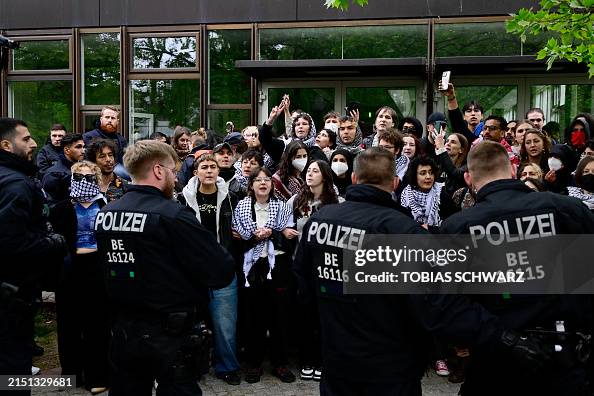
Germany, on May 7, 2024 (Photo by Tobias SCHWARZ / AFP) (Photo by TOBIAS SCHWARZ/AFP via Getty Images)
Rechtlich stützt sich die Einführung auf die Regelungen zur automatisierten Datenanalyse nach dem Polizeigesetz zum Zweck der Gefahrenabwehr. Wenn die gesetzlichen Voraussetzungen erfüllt sind, können die dabei gewonnenen Informationen auch in Strafverfahren verwendet werden. Nach § 147 StPO besteht ein allgemeines Recht auf Akteneinsicht, das auch Daten umfasst, die durch automatisierte Analyse erhoben oder ausgewertet wurden3.
Das Maßnahmenpaket4 sowie die Pressemitteilung vom 24. September 2024 („Umfassendes Sicherheitspaket beschlossen“5) legen die Leitlinien von „Sicherheit stärken, Migration ordnen, Radikalisierung vorbeugen“ fest – und verankern Palantirs System (Gotham/Foundry) bzw. VeRA als zentrale Bausteine dieser Strategie. Damit wird die polizeiliche Datenintegration politisch priorisiert, rechtlich gerahmt und zeitlich terminiert (Testbetrieb Ende 2025, Vollbetrieb im 2. Quartal 2026). Das Paket ist daher zentral, um die Reichweite, Legitimation und Beschleunigung der Einführung zu verstehen.
Gleichzeitig ruft die Einführung des Systems erhebliche Bedenken hervor. Kritiker*innen warnen vor der möglichen Legitimierung und Normalisierung polizeilicher Gewalt, der Verstärkung rassistischer Polizeipraktiken und Racial Profiling, der gezielten Überwachung von Asylsuchenden und Migrant*innen, der Ausweitung staatlicher Kontrolle über soziale Medienund digitale Räume sowie der Unterdrückung politischer Meinungsäußerung – insbesondere der Solidarität mit Palästina. Dies birgt die Gefahr einer allgemeinen Einschüchterung und Einschränkung von Dissens.
Der folgende Abschnitt untersucht die Tragweite und Berechtigung der gennanten Befürchtungen.
Über Palantir
CHINA – 2024/06/21: (Photo Illustration by Budrul Chukrut/SOPA Images/LightRocket via Getty Images)
Palantir ist ein US-amerikanisches Überwachungs- und „Defense-Tech“-Unternehmen, das vom Tech-Milliardär Peter Thiel mitbegründet und in seiner Anfangsphase vom CIA-Risikokapitalfonds In-Q-Tel finanziert wurde6. Das Unternehmen entwickelt Software zur Integration und Analyse großer Datenmengen, die von Nachrichtendiensten, Militärbehörden sowie US-Strafverfolgungs- und Einwanderungsbehörden ebenso genutzt wird wie von israelischen Militär- und Geheimdienststellen7.
Palantir89ist ein äußerst undurchsichtiges Unternehmen; aus öffentlich zugänglichen Materialien lässt sich nur schwer erkennen, was seine Systeme konkret leisten oder zu welchem Zweck sie eingesetzt werden. Eines wird jedoch aus der eigenen Vermarktung deutlich: Palantir bewegt sich klar im Umfeld von Verteidigung und Geheimdiensten. Gotham wird in der Sprache von Waffen, Schlachtfeldern, Zielerfassung und Kommandoeinsatz beworben, während Foundry als die datenbasierte Grundlage dargestellt wird, die solche Operationen ermöglicht. Beide Systeme bilden die zentralen Bausteine des VeRA-Systems, das – wie zuvor beschrieben – von der Polizei in Baden-Württemberg eingesetzt werden soll.
Im Jahr 2020 kam Amnesty International zu dem Schluss, dass Palantir seinen menschenrechtlichen Sorgfaltspflichten gemäß den UN-Leitprinzipien für Wirtschaft und Menschenrechte (UNGPs) nicht nachkommt. Diese Prinzipien verpflichten Unternehmen dazu, die Menschenrechte in allen Geschäftsbereichen und Wertschöpfungsketten zu achten, und fordern von Staaten, verbindliche Regeln zu schaffen und deren Einhaltung – insbesondere bei öffentlichen Aufträgen – sicherzustellen10.
Komplizenschaft im Genozid
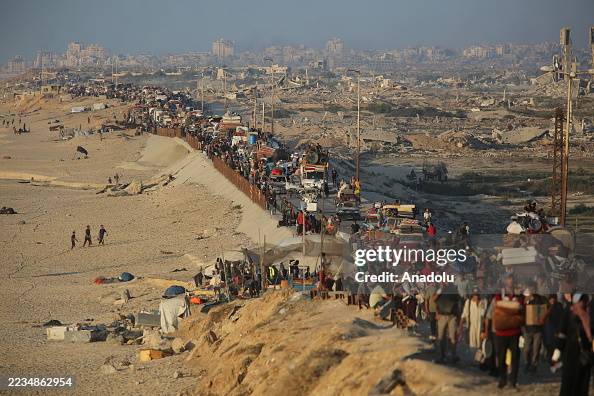
GAZA CITY, GAZA – SEPTEMBER 14: (Photo by Hassan Jedi/Anadolu via Getty Images)
Nach dem Beginn des genozidalen Krieges Israels gegen Gaza im Oktober 2023 schloss Palantir eine „strategische Partnerschaft“ mit dem israelischen Verteidigungsministerium, um die Kriegsführung zu unterstützen, und berichtete anschließend von einer „stark gestiegenen Nachfrage Israels nach neuen Werkzeugen“. Seitdem liefert das Unternehmen Gotham und Foundry – dieselben Systeme, die auch in Baden-Württemberg eingesetzt werden sollen.
Palantir steht auf der BDS-Desinvestitionsliste, was die anhaltenden zivilgesellschaftlichen Bedenken hinsichtlich seiner Verstrickung in Menschenrechtsverletzungen widerspiegelt11.
Der UN-Bericht „From Economy of Occupation to Economy of Genocide“12 führt Palantir unter den am Völkermord beteiligten Unternehmen auf. Es bestehen demnach begründete Anhaltspunkte, dass Palantir
automatisierte Predictive-Policing-Technologien,
zentrale Verteidigungsinfrastruktur für den schnellen und großflächigen Einsatz militärischer Software, sowie
eine KI-Plattform zur Integration von Echtzeit-Schlachtfelddaten für automatisierte Entscheidungsprozesse bereitgestellt hat.
Palantir-CEO Alex Karp erklärte als Reaktion auf den Vorwurf, dass Palantirs Systeme zum Töten von Palästinenser*innen in Gaza beigetragen hätten: „Meistens Terroristen, das stimmt.“ Diese Äußerung verdeutlicht eine bewusste Kenntnis und Billigung auf Führungsebene im Hinblick auf den rechtswidrigen Einsatz von Gewalt durch Israel sowie das unterlassene Handeln, um sich von diesen Verbrechen zu distanzieren13.
Rassismus
BERLIN, GERMANY – MAY 11: (Photo by Maryam Majd/Getty Images)
Das Maßnahmenpaket „Sicherheit stärken, Migration ordnen, Radikalisierung vorbeugen“14 stellt Migrant*innen und „gefährliche Ausländer“ als Sicherheitsrisiko dar. Wird dieses Framing mit Palantirs Software verbunden, führt es zu einer stärkeren Erfassung, Verknüpfung und Nutzung polizeilicher Daten über rassifizierte Gruppen.
Palantirs Software kann Personen erfassen, ohne dass sie etwas getan haben: ein Zeugenbericht, eine Routinekontrolle am Bahnhof oder die bloße Nähe zu einer gesuchten Person können ausreichen, um im System zu erscheinen. Datenschutzexpert*innen warnen, dass ein bundesweiter Einsatz große Gruppen unbeteiligter Menschen zusätzlichen Kontrollen und Maßnahmen aussetzen würde15. Mit dem Erstarken der AfD besteht die Gefahr, dass solche Systeme zur Abschiebung oder breiten Migrationsüberwachung genutzt werden – ähnlich wie in den USA unter Trump16.
Dies trifft auf eine bereits bestehende Realität rassistischer Polizeigewalt in Deutschland. Angehörige, Überlebende und migrantische Communities machen seit Jahrzehnten auf diese Gewalt aufmerksam. Fälle wie Lorenz A., der in Oldenburg von der Polizei erschossen wurde, und Nelson, der mit 15 Jahren in der Justizvollzugsanstalt Ottweiler starb, zeigen, dass Schwarze Menschen und andere rassifizierte Gruppen durch staatliches Handeln besonders gefährdet sind. Ihre Familien fordern Aufklärung und Verantwortung17.
Zwischen 1990 und 2022 hat die ISD gemeinsam in der Kampagne Death in Custody recherchiert und dokumentiert: Mindestens 203 Menschen starben in Deutschland in polizeilichem oder justiziellem Gewahrsam18.
Die Integration von Palantir in diese Praxis übernimmt die bereits in polizeilichen Datensätzen vorhandenen Verzerrungen durch Racial Profiling. Automatisierte Analysen verbreiten diese Vorurteile weiter über verknüpfte Systeme. So entsteht ein Kreislauf: voreingenommene Daten führen zu erweiterten Verdächtigungen. Ohne klare Grenzen, unabhängige Kontrolle und Transparenz wird VeRA den Umfang diskriminierender Polizeiarbeit und das Risiko von Polizeigewalt vergrößern.
Migrationspolitik
TOPSHOT – View into rooms in lightweight construction where clothes are hung up at the refugee accomodation at the former Tempelhof airport in Berlin on December 9, 2015. (Photo by TOBIAS SCHWARZ / AFP) (Photo by TOBIAS SCHWARZ/AFP via Getty Images)
Laut dem Maßnahmenpaket19 wird die geplante Einführung von Palantir-Software in VeRA ausdrücklich als ein Frühinterventionsinstrument dargestellt, das „kriminellen Karrieren“ unter ausländischen Staatsangehörigen vorbeugen und den Aufenthalt straffälliger Ausländer so früh wie möglich beenden soll. Diese Fallbearbeitungseinheit soll unterhalb des Sonderstabs Gefährliche Ausländer angesiedelt werden und damit den Fokus auf ausländische Straftäter*innen in aufenthaltsbeendenden Verfahren weiter verstärken20.
Die Formulierungen des Dokuments – insbesondere die Verknüpfung von VeRA mit der Bekämpfung „zunehmenden islamistischen Terrorismus“ und „gefährlicher Zuwanderung“ – spiegeln dabei deutlich US-amerikanische Sicherheits- und Migrationsnarrative wider.
Angesichts dieser Zielsetzungen ist ein Vergleich mit den Vereinigten Staaten naheliegend. Palantir-gestützte Systeme stehen dort seit Langem in der Kritik wegen ihrer Rolle bei der Durchsetzung von Einwanderungsgesetzen, insbesondere an der US-mexikanischen Grenze. Auf Grundlage von Unterlagen des Department of Homeland Security sowie Beschaffungs- und Datenschutzdokumenten zeigt Amnesty International, dass KI-gestützte Systeme – darunter auch Palantir-Technologien – eine permanente, großflächige Überwachung und Risikobewertung ermöglichen, die sich häufig gezielt gegen Nicht-US-Bürger*innen richtet21.
Darüber hinaus dokumentiert Amnesty, dass diese Systeme zur Überwachung und Nachverfolgung von Migrant*innen, Geflüchteten und Asylsuchenden eingesetzt werden und ein hohes Risiko bergen, in Programmen wie „Catch and Revoke“ verwendet zu werden. Frühere Untersuchungen belegen zudem den Einsatz von Palantir-Systemen durch die US-Einwanderungsbehörde ICE zur Umsetzung menschenrechtswidriger Maßnahmen gegen Migrant*innen und Asylsuchende – ein Beispiel für das erhebliche Risiko, dass Palantirs Technologie zur Ermöglichung von Menschenrechtsverletzungen beiträgt22.
Palästinasolidarität
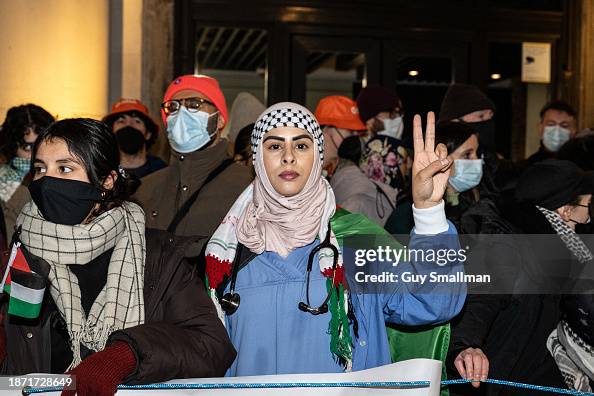
LONDON, ENGLAND – DECEMBER 21:(Photo by Guy Smallman/Getty Images)
Die im Maßnahmenpaket23 geplante Desinformationsdimension ist besonders beunruhigend: Angesichts der systematischen Leugnung der Fakten über Gaza, der Normalisierung von Handlungen Israels, die einen Völkermord darstellen, und der anhaltenden Weigerung der deutschen Regierung, ihren verfassungsrechtlichen und historischen Verpflichtungen nachzukommen – Mitverantwortung zu beenden und wirksame Schritte zum Schutz der Zivilbevölkerung zu ergreifen – stellt sich die Frage, wer die Wahrheit kontrolliert. Wie Humpty Dumpty in Through the Looking-Glass formuliert: Wörter bedeuten, was diejenigen in Machtpositionen bestimmen – „wer der Meister ist“.
„Wenn ich ein Wort benutze“, sagte Humpty Dumpty in einem ziemlich verächtlichen Ton, „dann bedeutet es genau das, was ich will – nicht mehr und nicht weniger.“ „Die Frage ist“, sagte Alice, „ob man Worte so viele verschiedene Dinge bedeuten lassen kann.“ „Die Frage ist“, sagte Humpty Dumpty, „wer der Meister ist – das ist alles.“
In den Vereinigten Staaten hat sich der Einsatz von Palantir-Software bereits mit der Repression gegen die Palästina-Solidaritätsbewegung überschnitten. Am 8. März 2025 verhafteten die Behörden rechtswidrig Mahmoud Khalil, einen ehemaligen Doktoranden der Columbia University und ständigen US-Residenten, der als Sprecher der Campusproteste fungiert hatte; Präsident Trump erklärte, dies sei „die erste von vielen Verhaftungen“. Kurz darauf wurden Visa oder Aufenthaltsgenehmigungen von neun ausländischen Studierenden widerrufen, die an Protesten teilgenommen oder sich gegen Israels Handeln in Gaza ausgesprochen hatten; weitere Fälle dokumentierte Amnesty International24.
Vor diesem Hintergrund – polizeiliche Gewalt bei Demonstrationen und pauschale Antisemitismusvorwürfe gegen die Bewegung in Deutschland – bergen erweiterte Datenfusionswerkzeuge erhebliche Risiken. Eine solche Semantik staatlicher Deutungshoheit zeigt sich bereits in Veröffentlichungen des Bundesamts für Verfassungsschutz, das Palästina-Solidarität pauschal in den Kontext „dogmatischen Linksextremismus“ rückt und damit den Boden für Überwachung und Kriminalisierung bereitet25.
Ein System, das Erfassung, Querverknüpfung und automatisierte Auswertung zentralisiert, kann unter dem Etikett „öffentliche Sicherheit“ zur Überwachung, Einschüchterung und Kriminalisierung von Dissens eingesetzt werden und semantische Kämpfe um Bedeutung in operative Kategorien staatlicher Repression übersetzen.
Schlussfolgerung
(Photo by Odd ANDERSEN / AFP) (Photo by ODD ANDERSEN/AFP via Getty Images)
Die Einführung von Palantir und VeRA in Baden-Württemberg steht nicht isoliert, sondern in einem größeren politischen und historischen Zusammenhang. Das Unternehmen ist direkt in militärische und sicherheitspolitische Operationen verwickelt, die in Gaza zu Kriegsverbrechen und Völkermord beigetragen haben. Seine Technologie wurde in den USA eingesetzt, um Migrant*innen zu überwachen, abzuschieben und Proteste gegen Israels Politik zu unterdrücken. Diese Erfahrungen zeigen, dass solche Systeme nicht neutral sind – sie dienen der Kontrolle, nicht dem Schutz.
In Deutschland trifft Palantirs Technologie auf eine politische Landschaft, in der Palästina-Solidarität kriminalisiert, Migration sicherheitspolitisch behandelt und rassistische Polizeipraxis seit Jahrzehnten ignoriert oder geleugnet wird. Das Maßnahmenpaket „Sicherheit stärken, Migration ordnen, Radikalisierung vorbeugen“ setzt diese Logik fort: es verschiebt gesellschaftliche Konflikte in den Bereich von „Sicherheit“ und schafft die technischen Grundlagen für Überwachung, Selektion und Ausschluss.
Palantir Software verbindet diese Ebenen – Kriegstechnologie, Migrationskontrolle und innere Repression – zu einem einheitlichen Überwachungsinstrument. Es institutionalisiert ein Denken, in dem soziale Probleme als Risiken erscheinen, Dissens als Bedrohung und ganze Bevölkerungsgruppen als potenziell gefährlich. In Kombination mit bestehenden Datensätzen, rassistischen Polizeistrukturen und dem politischen Klima der Angst entsteht ein Apparat, der Diskriminierung nicht abbaut, sondern automatisiert.
Die Einführung von Palantir in die deutsche Polizeiarbeit ist daher kein bloßer technischer Schritt, sondern ein politischer. Sie markiert eine Verschiebung – weg von Rechtsstaatlichkeit und öffentlicher Rechenschaft, hin zu algorithmischer Kontrolle und selektiver Sicherheit. Eine demokratische Gesellschaft kann sich solche Systeme nur leisten, wenn sie bereit ist, sich selbst in Daten zu zerlegen. Wer das zulässt, überlässt die Deutung der Wirklichkeit – und damit die Macht – jenen, „die die Wörter beherrschen“.
Was tun?
Wir nehmen die Straße. Wir stehen dagegen.
Schließ dich uns an. Lasst uns von unten eine Bewegung aufbauen.
Gemeinsam, solidarisch, organisiert – vereint sind wir nicht zu besiegen.
Before Auschwitz, Germany perpetrated its first genocide (1904–08) in South West Africa against the Herero and Nama—desert expulsions, poisoned waterholes, concentration camps, starvation, sexual violence, forced labor, identity badges, land seizure, and leadership suppression. This article centers the Namibia genocide, situates it in its colonial background, and traces its mechanisms and enduring legacies in land, memory, and reparations.
Together with many other groups, the Herero and Nama contribute to Namibia’s diverse heritage—while many individuals choose to identify first and foremost simply as Namibian, given the sensitivities shaped by the apartheid past.
The Herero are a historically cattle-herding society that developed from peoples, cultures, and economies already present in Namibia before European arrival in the 16th century1. Never a monolith, Herero politics included internal divisions that German colonial authorities later exploited to facilitate conquest2. Cattle remain central to social life and concepts of wealth, a symbolism reflected in the distinctive women’s attire—Victorian-influenced gowns and a horn-shaped headpiece often interpreted as evoking cattle horns.3
The Nama are among Namibia’s oldest population groups and one of more than a dozen ethnic, cultural, and linguistic communities. Traditionally pastoralist, they historically occupied wide areas in the country’s south and center4. Interactions with neighboring Herero included periods of conflict, after which German colonial authorities confined both peoples to reserves. Music, poetry, and storytelling are central to Nama cultural life, sustained by a rich oral tradition5.
Among Herero and Nama pastoral communities, land and vital resources like waterholes were held in common under customary authority, with seasonal movement of herds and households between pastures and water sources based on flexible, overlapping use rights. Colonial appropriation imposed private freehold and rigid, officially surveyed property lines, reinterpreting temporary permissions as permanent “sales” and restricting access to those with registered title—often on contested claims. This shift, foreign to local tenure, dismantled seasonal herd mobility and its ecological adaptation, making private ownership central to dispossession6.
The Bremen merchant Adolf Lüderitz hoisted the German flag in the bay of Angra Pequena and thus acquired Deutsch Southwest Africa, today Namibia, Historic, digitally restored reproduction of an original artwork from the early 20th century, exact original date not known. (Photo by: Bildagentur-online/Universal Images Group via Getty Images)
Initial contact between Germans and the Herero and Nama came via missionaries, followed by traders, concession hunters, and other colonial ventures. Even before formal colonization, these ventures undermined Herero and Nama socio-economic life through fraudulent trading practices, coercive “protection” treaties, and land deals that dispossessed communities7. In 1884–85, Bismarck directly convened the Berlin Conference to codify European claims and manage rivalries during the “Scramble for Africa.” Excluding African representatives, the conference legitimized the partition and expropriation of African territories— described as the organized commission of a crime against Africa’s peoples8.
Colony
On 30 April 1885, the German South West Africa Company (Deutsche Kolonialgesellschaft für Südwestafrika) was founded and soon absorbed earlier private concessions in the territory9. Its shareholders included some of Germany’s wealthiest magnates—Hansemann, Bleichröder, the Duke of Ujest, and Count Henckel von Donnersmarck—and finance capital was prominently represented by the Disconto-Gesellschaft, Deutsche Bank, Delbrück, Leo & Co., Dresdner Bank, and Bankhaus Oppenheim10.
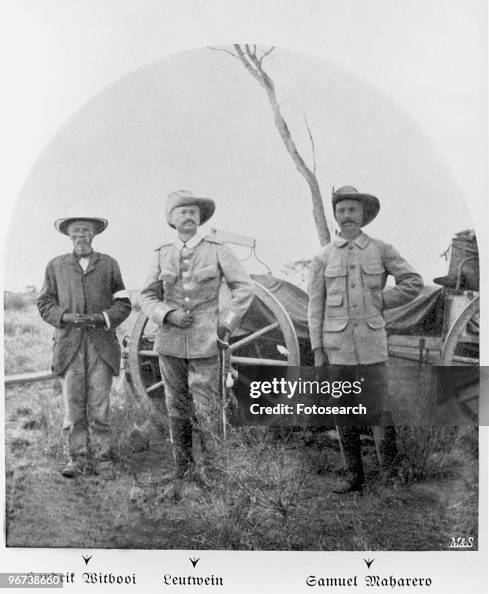
The main factions of the Herero and Nama were led by Samuel Maherero, and Hendrik Witbooi respectively.
After nearly a century of conflict between the Herero and Nama, a peace concluded in November 1892—spurred by the growing threat of German and Boer expansion—realigned forces and, by early 1893, presented a united African front that alarmed German colonial authorities, who could no longer exploit inter-African divisions. In the early hours of 12 April 1893, German troops reached Hornkranz (a Nama encampement)—described by Captain François as tranquil—and, on his orders, opened fire from three directions, expending roughly 16,000 rounds from 200 rifles in about thirty minutes; seventy-eight women and children were killed. When the incident was raised in the Reichstag, the government advanced a fabricated claim that Witbooi fighters had used women as cover to explain the high civilian toll.
Theodor Leutwein standing with Samuel Maharero and Hendrik Witbooi circa 1900. (Photo by Fotosearch/Getty Images).
Subsequently, Nama leader Hendrik Witbooi waged a vigorous campaign against German forces, inflicting significant losses and contributing to the recall of Major Curt von François, who was replaced in 1894 by Theodor Leutwein11. On 15 September 1894—after roughly eighteen months of fighting and confronted by German superiority in firearms—Witbooi was compelled to sign a “treaty of protection and friendship.” The war left the Witbooi impoverished, a condition Leutwein exploited by lending them 150 head of cattle for three years to bind them more closely to colonial authority12.
In 1896, the rinderpest epidemic reached Namibia just as colonial pressure was confining the Herero to ever smaller quarters, crowding herds and making them acutely vulnerable13; moreover, German vaccination campaigns were misused to hasten the destruction of Herero cattle and to acquire land14. Socially, rinderpest transformed Herero society: the collapse of the cattle economy forced commoners into wage or indentured labor, while chiefs sold large tracts to traders and land companies, opening more territory to settler occupation and deepening dispossession15. In its wake the Herero lost land, people, and herds, sank further into debt, and became dependent on the colonial state for reserves, food, and employment; on traders and settlers for credit and work; and on missions for religious guidance1617.
With an approximate 90 per cent of cattle wiped out by the pandemic many pastoralists in the central and southern parts of the territory were forced into wage labour for the first time. By 1904, Herero communities had become scattered groupings clustered around garrison towns under German control and their associated chiefs—effectively stripped of independence as the colonial state prevailed.18
In 1904, the Herero, led by Samuel Maherero rose up in resistance19.
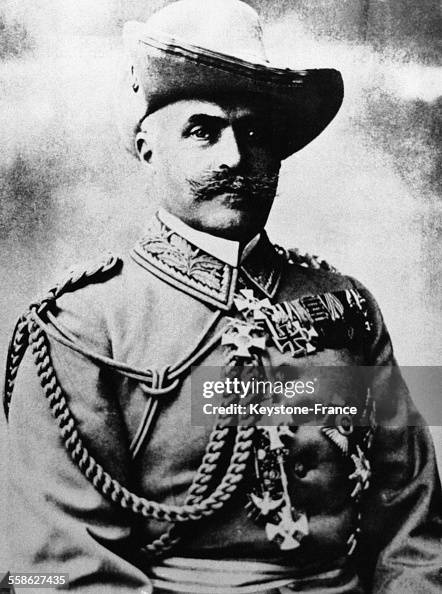
German authorities manufactured atrocity propaganda—especially lurid, unproven claims that Herero had raped or “butchered” white women—to furnish a moral pretext for annihilation; internal cables show pressure on Governor Leutwein to label vague “ill-treatment” as rape despite no evidence, and even after missionary J. Irle publicly debunked named cases the narratives persisted. This drumbeat conditioned soldiers and the public, normalizing calls for collective reprisals, encirclement and destruction by artillery, and even poisoning wells. Amid a jingoistic settler climate—and with the Kaiser Wilhelm II’s endorsement—Berlin ordered an immediate offensive, forbade negotiations with the Herero, removed Leutwein, and installed Lieutenant-General Lothar von Trotha to prosecute an exterminationist campaign20.
While Leutwein did not “want to see the Herero destroyed altogether”; beyond the practical difficulty of annihilating “a people of 60,000 or 70,000,” he deemed such a course “a grave mistake from an economic point of view,” insisting that “we need the Herero as cattle breeders, though on a small scale, and especially as laborers,” and that “it will be quite sufficient if they are politically dead.” By contrast, Lothar von Trotha set out a different procedure: “to encircle the masses of Hereros at Waterberg, and to annihilate these masses with a simultaneous blow,” then establish stations “to hunt down and disarm the splinter groups who escaped,” “lay hands on the captains by putting prize money on their heads,” and “finally to sentence them to death.”21
In early August 1904, von Trotha issued battle orders to his troops. What followed is genocide…
Genocide
NON SPECIFIE – 1905: Portrait de Lothar von Trotha, général allemand des forces coloniales, en Afrique en 1905. (Photo by Keystone-France\Gamma-Rapho via Getty Images)
The Herero are no longer German subjects. They have murdered and stolen, they have cut off the ears, noses and other bodyparts of wounded soldiers, now out of cowardice they no longer wish to fïght. I say to the people anyone who delivers a captain will receive 1000 Mark, whoever delivers Samuel will receive 5000 Mark. The Herero people must however leave the land. If the populace does not do this I will force them with the Groot Rohr [Cannon]. Within the German borders every Herero, with or without a gun, with or without cattle, will be shot. I will no longer accept women and children, I will drive them back to their people or I will let them be shot at. These are my words to the Herero people.
General von Trotha, Sunday 2 October 1904 (der Vernichtungsbefehl) 22
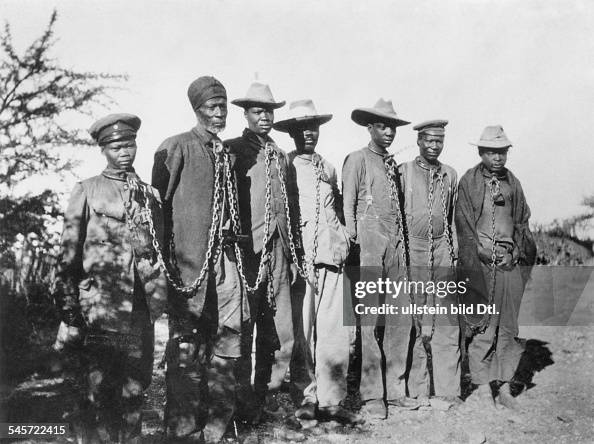
Men, women, and children were forced into concentration camps; starved and malnourished; whipped, raped, and compelled to perform backbreaking labor. Many were “tattooed and forced to wear identity badges”; the Herero were coerced to change religion, their land was seized and sold to German settlers, and their ruling structures were banned. Waterholes were poisoned, and people were hunted and lynched. Herero prisoners of war—and later Nama prisoners—were deployed across civilian firms (from laundries and transport contractors to breweries and shipping companies), while military units used prisoners, often children, to maintain livestock—building kraals, pumping water, cutting fodder, and herding—and to build railway lines232425.
it has been and remains my policy to exercise the violence with gross terrorism and even with cruelty. I annihilate the African tribes by floods of money and floods of blood; it is only by such sowings that a [new permanent German state] will be there to stay.
By early 1905, Herero society as it had existed prior to 1904 was destroyed, the majority were confined to camps and left propertyless, landless, and leaderless, and legislation sought to perpetuate this condition; when the camps were abolished in 1908, Imperial Germany aimed to reshape the survivors of the genocide into a single, amorphous Black working class27.
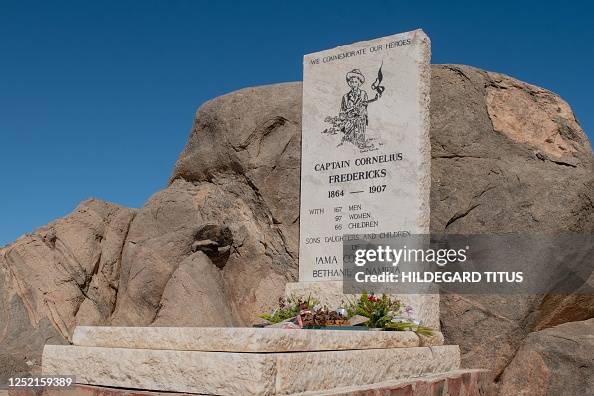
Germany established a network of concentration camps in South West Africa; Shark Island—opened first for Herero prisoners whose forced labor was exploited for colonial infrastructure, including the Lüderitz–Aus railway and harbor—later received Nama inmates in 190628. Between 1,000 and 3,000 people died there, chiefly from exposure, disease, and exhaustion under brutal conditions, while terror practices included rape, torture, poisoning, medical experiments, and public executions; captive women were forced to clean the skulls of the dead for shipment to Germany for pseudo-scientific research29. Among those who perished was the Nama Cornelius Fredericks, decapitated on 16 February 1907, his skull sent to Germany. When the camp closed in April 1907, survivors were transferred to a “Burenkamp” at Radford Bay30.
(Eingeschränkte Rechte für bestimmte redaktionelle Kunden in Deutschland. Limited rights for specific editorial clients in Germany.) German South-West Africa: Herero rebellion, captives in chaines – 1904/5 (Photo by ullstein bild/ullstein bild via Getty Images)
Between 75 and 80 per cent of the Herero and about 50 per cent of the Nama were exterminated by the German forces31.
Resistance
From the standpoint of Ovaherero and Nama communities, German rule meant near-total rightlessness. Openly racist dehumanization normalized violence—from routine whipping to killings—often excused as “tropical frenzy.” Courts rarely punished German perpetrators, discounted African testimony (even proposing ratios that devalued it), and imposed only light sentences when cases proceeded at all. Stripped of legal protection and credibility, Herero and Nama experienced life as slavery in their own country32.
All our obedience and patience with the Germans is of little avail, for each day they shoot someone dead for no reason at all. Hence I appeal to you, my Brother, not to hold aloof from the uprising, but to make your voice heard so that all Africa may take up arms against the Germans. Let us die fighting rather than die as a result of maltreatment, imprisonment or some other calamity. Tell all the kapteins down there to rise and do battle.
Letter of Samuel Maherero to Hendrik Witbooi, 11 January 1904 33
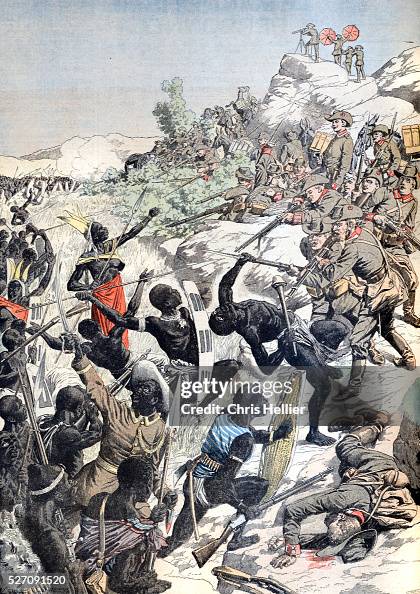
On 12 January 1904, the Herero rose in arms, swiftly seizing most of their ancestral land—fortified posts excepted, which came under siege—and capturing the bulk of settlers’ livestock; over 100 German settlers and soldiers were killed. In October 1904, the Nama joined the uprising. Employing guerrilla tactics—ambushes, hit-and-run raids, and disruption of lines of communication—the resistance forced German forces onto the defensive and, for a time, severely constrained their operations34.
Battle Between Herero Warriors & German Colonials or Colonists Windhoek Namibia (Feb 1904) (Photo by Chris Hellier/Corbis via Getty Images)
The memorial site for Captain Corlnelius Fredricks on the Shark Island peninsula near Luderiz, Namibia, is seen in this April 24, 2023 image. Captain Fredricks, who died in 1907 at the camp in Shark Island, was one of the indigenousleaders who fought a guerrilla-style war against the Germans in the German South-West Africa, now Namibia. – A genocide memorial tombstone has been unveiled during a three-day event on Shark Island, a peninsula off the southern city of Luderitz that hosted a camp of the same name — one of several set up during German rule as part of a system of repression. Namibia has no official day designated to commemorate what some historians have described as the 20th century’s first genocide. German settlers killed tens of thousands of men, women and children belonging to indigenous Herero and Nama people who rebelled against colonial rule in the southwest African country between 1904 and 1908. (Photo by HILDEGARD TITUS / AFP) (Photo by HILDEGARD TITUS/AFP via Getty Images)
1893–1903 saw a systematic transfer of Herero and Nama land and cattle to German settlers, culminating after the 1904–07 uprisings were crushed. Colonial acquisitions proceeded under colonial legal forms. These sales were completed amid documented protests by Herero and Nama, who contested their legality35. The large scale dispossession of black Namibians was as much intended to provide white settlers with land, as it was to deny black Namibians access to the same land, thereby denying them access to commercial agricultural production and forcing them into wage labour36.
Vast land seizures and the expropriation of more than 205,640 head of cattle (1884–1915) dismantled Herero and Nama livelihoods, entrenched long-term land inequality, and drove dispersal and diaspora, while extractive gains in minerals, diamonds, and forced labor enriched German settlers, companies, and the colonial state. These structures persist today in unequal access to land and the concentration of ownership in the hands of white German-speaking Namibians and foreign nationals, reinforced by ongoing German financial ties and influence. The removal of human remains for scientific and medical research—some still retained in Germany—marks a continuing cultural and epistemic dispossession. Together, the loss of economic and political power, damage to cultural identity, and intergenerational trauma continue to burden Herero and Nama communities, with inadequate land access compounding present-day socio-economic marginalization37.
To quote Edward Said, “To think about distant places, to colonize them, to populate or depopulate them: all of this occurs on, about, or because of land. The actual geographical possession of land is what empire in the final analysis is all about”38. When you take that quote and the fact that white Namibians still hold most of the privately owned land in the country, you see that the colonial “empire” and its strength have hardly been reduced at all. The structure that empire created remains fundamentally intact. And as long as this remains so, inequality can never be overcome39.
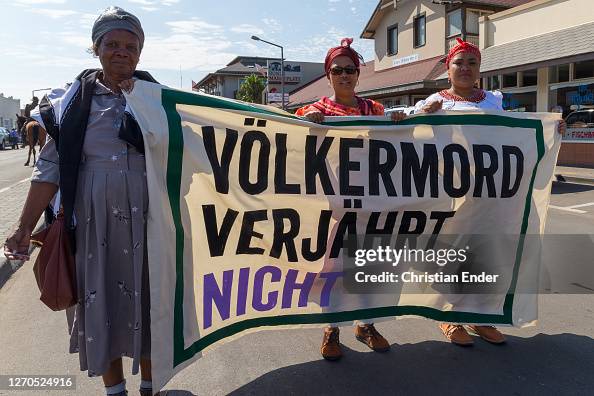
SWAKOPMUND, NAMIBIA – MARCH, 27: A memorial stone in honor of the OvaHerero/OvaMbanderu and Nama people that were victims of the genocide by German colonial forces on the begining of the 20th century stands at the Swakopmund Concentration Camp Memorial, in Swakopmund, Namibia, on March 27, 2019. Located on the coast of Namibia, Swakopmund is one of the most populous cities in the country and one of the best preserved examples of German colonial architecture in the world. Since 2007, every year, at the end of March, people of the Herero and Nama communities take part on the „Swakopmund Reparation Walk“, organized to honor the victims of the German colonial power over the country and to demand reparation from the German state. (Photo by Christian Ender/Getty Images)
Postscript
Selecting sources for this article has been unexpectedly difficult. I have chosen to cite only works that explicitly name the events a genocide. More troubling is how little accessible scholarship exists online about Herero and Nama before German colonization; much of the record makes their histories appear to begin with the colonial encounter. This reflects structural biases—digitized collections dominated by colonial archives, scarcity of materials in Otjiherero and Khoekhoegowab, paywalled journals, and search algorithms that privilege widely cited European-language sources. As a result, most available references are authored by Germans or, more broadly, by scholars of European heritage. There are important exceptions, however, and I make a point of foregrounding and citing those works more heavily.
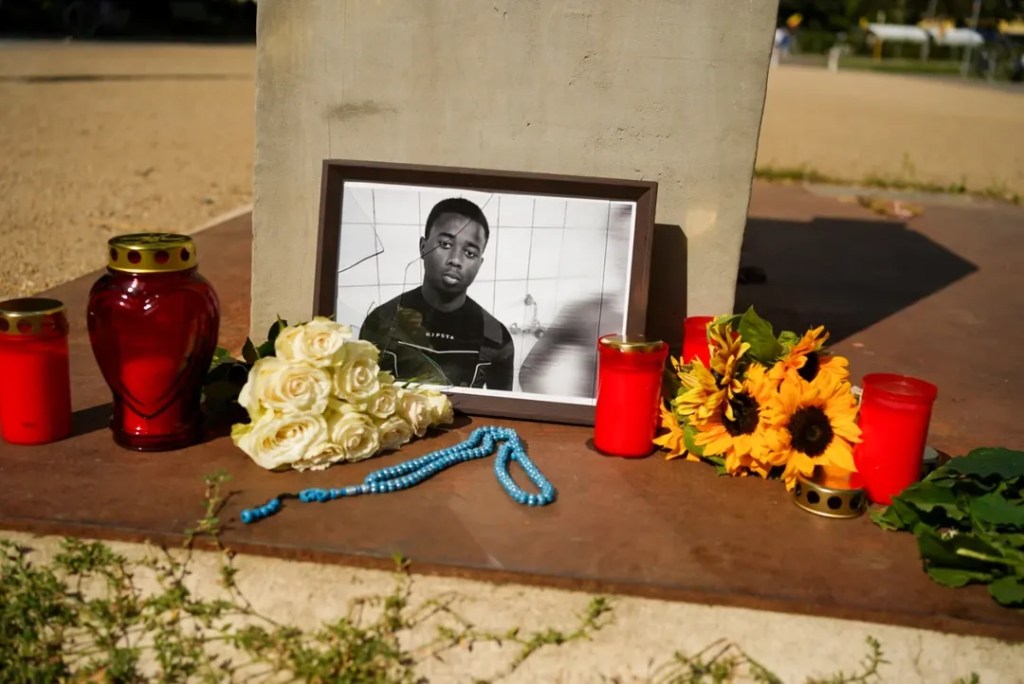
Am 1. August 2025 starb der 15-jährige Nelson, ein Schwarzer Jugendlicher, in der Justizvollzugsanstalt Ottweiler. Die Staatsanwaltschaft erklärte schnell, es handele sich um Suizid. Auch die Obduktion habe „keine Hinweise auf Fremdeinwirkung“ ergeben.
Doch Mitinhaftierte berichten eine andere Geschichte. Sie sagen, Nelson sei kurz vor seinem Tod von mindestens einem Justizbeamten getreten und geschlagen worden – angeblich wegen gestohlener Süßigkeiten. Kurz danach war Nelson tot.
Aus Protest weigerten sich 17 Gefangene, nach der Freistunde in ihre Zellen zurückzukehren. Sie forderten Gerechtigkeit für Nelson und prangerten die schlechten Haftbedingungen an. Ein Spezialeinsatzkommando wurde geschickt, um den Protest niederzuschlagen. Drei Inhaftierte, die als „Rädelsführer“ gelten, wurden inzwischen in Gefängnisse nach Rheinland-Pfalz und Baden-Württemberg verlegt – andere müssen ebenfalls mit Konsequenzen rechnen.
Inzwischen ermittelt die Staatsanwaltschaft gegen mehrere Beamte wegen Körperverletzung. Nelsons Vater hat Strafanzeige gestellt. Viele Fragen bleiben offen: Warum war Nelson überhaupt in Haft? War er schon verurteilt oder noch in Untersuchungshaft? Und warum wurde er fünf Wochen lang in „sicherer Verwahrung“ isoliert und zusätzlich per Video überwacht?
Familie, Freund:innen und die Community trauern um Nelson, der als fröhlicher und hilfsbereiter Junge beschrieben wird. Er war 15 Jahre alt. Ein Kind.
Sowohl die Initiative Schwarzer Menschen in Deutschland (ISD) als auch die Kampagne für Opfer rassistischer Polizeigewalt (KOP) machen deutlich: Nelsons Tod ist kein tragischer Einzelfall, sondern Teil eines tödlichen Systems, das von strukturellem Rassismus und institutioneller Verantwortungslosigkeit geprägt ist.
Die ISD verweist auf die gemeinsame Kampagne Death in Custody, die zwischen 1990 und 2022 mindestens 203 Todesfälle von rassifizierten Menschen in polizeilichem oder justiziellem Gewahrsam dokumentiert hat. Von Rassismus betroffene Menschen sind einem besonders hohen Risiko ausgesetzt, in staatlichem Gewahrsam zu sterben.
KOP betont, dass Gefängnisse Orte staatlicher Repression, Kontrolle und Überwachung sind, die Menschen brechen und isolieren, aber keine gesellschaftlichen Probleme lösen. Nelsons Tod reiht sich ein in eine lange Kontinuität tödlicher rassistischer Gewalt: Oury Jalloh, Ferhat Mayouf, Rachid S., Fartoun Haroun Ali, Rooble Warsame, Laye-Alama Condé. Immer wieder heißt es offiziell: „Kein Hinweis auf Fremdverschulden.“ Immer wieder bleiben Familien und Communities mit Trauer zurück – während Täter:innen straflos bleiben.
ISD und KOP fordern gemeinsam:
eine unabhängige, öffentliche und umfassende Untersuchung von Nelsons Tod
volle Transparenz statt Schweigen
keine Repression gegen die Mitinhaftierten
die sofortige Suspendierung der beschuldigten Beamten
die Einführung einer bundesweiten Meldepflicht für alle Todesfälle in Gewahrsam
Nelsons Leben zählt. Gerechtigkeit für Nelson heißt: Wahrheit, Verantwortung, Veränderung.
Nelsons Vater steht nun alleine da – mit Trauer und der Last, für Gerechtigkeit kämpfen zu müssen. Er braucht Unterstützung, um die Kosten für Anwält:innen, die Beerdigung und ein unabhängiges medizinisches Gutachten zu tragen.
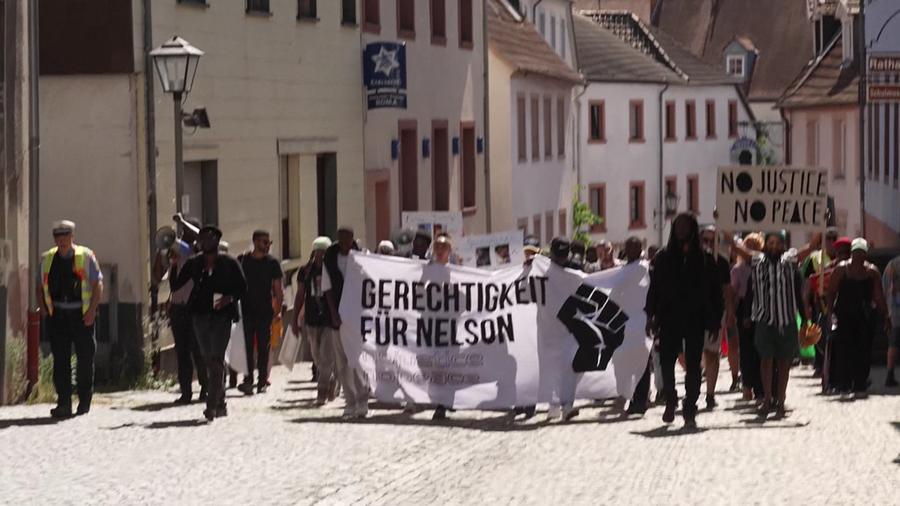
In Freiburg haben wir zusammen mit anderen Guppen eine Kundgebung organisiert, um Gerechtigkeit für Nelson zu fordern.
Wir fordern:
1. Die unabhängige & lückenlose Aufklärung von Nelsons Tod. 2. Die sofortige Suspendierung der beschundigten Beamten. 3. Eine öffentliche Erklärung des Justizministeriums über die Erkenntnisse & Maßnahmen. 4. Die Überprüfung des Umgangs mit Minderjährigen im Stafvollzug. 5. Schutz vor rassistischer Gewalt – auch hinter Gefängnismauern.









 tadamun