
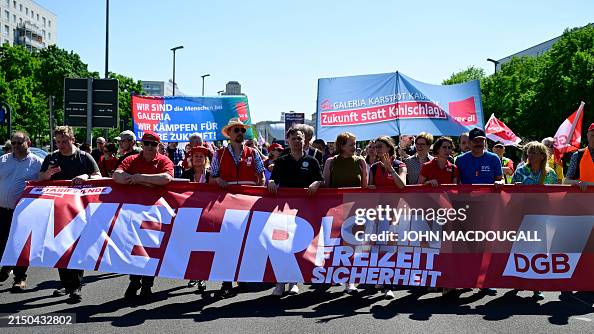
The German Trade Union Confederation (DGB) talks peace while backing rearmament and defending arms-industry jobs—this article maps the contradictions.
Background
Since Russia’s full-scale invasion of Ukraine in 2022, German politics has been marked by a sharp turn toward rearmament. The government’s €100-billion “Sondervermögen Bundeswehr,” NATO’s 2% spending target, and the EU’s ReArm Europe program all point to a new era of militarization. Trade unions, traditionally part of Germany’s peace movement, have been forced to position themselves in this landscape.
The German Trade Union Confederation (DGB) publicly continues to stress its commitment to peace, diplomacy, and disarmament. Its annual Antikriegstag statements, as well as the 2025 Easter March declaration, warn against a “spiral of blind militarization” and call for a broader understanding of security that includes diplomacy, crisis prevention, and social investment.
Yet at the same time, the DGB and its affiliates — especially IG Metall — are deeply entangled with the arms industry and have supported policy shifts that expand Germany’s military capacity. They endorse loosening the debt brake for defense, defend jobs in arms companies, and accept the logic of a stronger European military role.
The DGB today counts about 6 million members—far fewer than the roughly 8 million organized in free unions before 1933 and the 25 million claimed by the Nazi-era Arbeitsfront.
Peace Rhetoric vs. Rearmament Reality
The DGB presents itself as both a champion of social investment and a voice for peace. In its campaign against the debt brake, it warns that austerity is strangling the future:
“Die Schuldenbremse verhindert Investitionen in die öffentliche Infrastruktur und den Klimaschutz. Sie ist eine Zukunftsbremse für Deutschland.”
DGB, Schuldenbremse? Deutschland braucht eine Investitionsoffensive
(“The debt brake prevents investments in public infrastructure and climate protection. It is a brake on the future for Germany.” )
The unions demand nothing less than a fundamental reform:
“Wir fordern eine grundlegende Reform der Schuldenbremse, damit Deutschland die wichtigen Zukunftsaufgaben meistern und gleichwertige Lebensverhältnisse für alle schaffen kann.”
DGB, Schuldenbremse? Deutschland braucht eine Investitionsoffensive
(“We demand a fundamental reform of the debt brake so that Germany can master important future tasks and create equal living conditions for all.”)
Yet when it comes to defense, the language shifts. In its 2025 Easter March statement, the DGB simultaneously calls for “peace” while endorsing a build-up of Europe’s military capacity:
“Vor diesem Hintergrund sehen auch der DGB und seine Mitgliedsgewerkschaften die Notwendigkeit, in Deutschland und Europa verstärkte Anstrengungen zu unternehmen, um gemeinsam verteidigungsfähiger zu werden.”
DGB, Frieden sichern, Verteidigungsfähigkeit erhöhen, Militarisierung stoppen!
(“Against this background, the DGB and its member unions also see the need to make greater efforts in Germany and Europe to become more defense-capable together.”)
At the same time, the union federation warns of the dangers of militarization:
“Es wäre grundfalsch, damit in eine Spirale der blinden Militarisierung einzusteigen.”
DGB, Frieden sichern, Verteidigungsfähigkeit erhöhen, Militarisierung stoppen!
(“It would be fundamentally wrong to enter a spiral of blind militarization.”)
This dual stance highlights the contradiction: while opposing the debt brake for blocking social and climate investments, the DGB welcomes its loosening for military budgets — even as it insists it wants to “stop militarization.”
Partnership with the Arms Industry
The contradictions in the DGB’s position on militarization become clearest when looking at its largest affiliate, IG Metall, which organizes tens of thousands of workers in the arms sector.
A recent example is the conflict around LITEF in Freiburg, a company producing avionics systems used in both civilian and military applications. When peace activists criticized the firm as part of the war industry, IG Metall defended its members by insisting on the company’s civilian profile:
“LITEF produziert zivile Produkte – und genau deshalb ist es richtig, die Arbeitsplätze zu schützen.”
IG Metall Freiburg, Statement on the Antikriegstag controversy, RDL, 2019
(“LITEF produces civil products – and that is precisely why it is right to protect the jobs.” )
At the same time, IG Metall openly celebrated securing 100 jobs at LITEF, emphasizing its role in protecting employment in the sector:
“Zusammen nötigen Druck aufgebaut … und 100 Arbeitsplätze bei LITEF gesichert.”
IG Metall, Metallzeitung, April 2019
(“Together we exerted the necessary pressure … and secured 100 jobs at LITEF.” )
These positions sit uneasily alongside DGB’s Antikriegstag declarations against rearmament and militarization. While unions issue statements condemning militarization, they simultaneously act as institutional guarantors of the arms industry’s workforce and production capacity.
The contradiction is even sharper when looking at IG Metall’s broader network: it organizes workers at Thyssenkrupp Marine Systems (submarines, warships), Rheinmetall (tanks, artillery, ammunition), and Airbus Defence & Space (combat aircraft, drones, satellite systems). These companies are pillars of the German and European arms industry — and IG Metall plays a key role in defending their jobs, production, and expansion plans.
In practice, this means the DGB’s peace rhetoric is consistently undercut by its function as a social partner in the arms economy. By protecting and institutionalizing jobs in weapons production, the unions help stabilize precisely the militarization that they claim to oppose.
Towards a True Working Class Solidarity
“Solidarity” cannot just mean protecting jobs in any sector, including those tied to war production. As long as unions remain bound to the government’s agenda—and the DGB has largely echoed state policy since its founding—the result is a narrow, national form of solidarity that stabilizes militarization rather than challenging it.
Compounding this, Germany bans strikes for political demands; only strikes tied to collective bargaining (Tarifauseinandersetzungen) are legal. This legal constraint has helped keep union power separate from anti-war politics as well as international solidarity.
The 1980s peace movement exposed these limits clearly. When hundreds of thousands formed the famous Menschenkette (human chain) against nuclear weapons in 1983, unions joined only as private citizens, not as organized workers. They refused to deploy strikes or work stoppages—the most powerful instruments of labor. (der DGB hatte ja gesagt, daß man als einzelner durchaus teilnehmen dürfe, nicht aber in gewerkschaftlicher Funktion.)
A true, internationalist working-class solidarity would require more: independence from the state, an extension of solidarity across borders to those who suffer under militarization, and the courage to connect workplace power with peace demands. Without this, union participation remains trapped in symbolism, repeating the pattern of the 1980s—loud in protest, but structurally aligned with the militarized status quo.
 tadamun