I’ve resisted a bit writing about this topic, out of fear of being too clichè—but also because it can be argued that what I’m going to talk about is a given, proven time and again throughout history. And yet, with the realities we—as Palestinians and as human beings within our struggle for liberation—are facing, it becomes all the more important to remind ourselves that our existence can manifest itself through our continuous artworks, in their various forms.
In a world that constantly tries to reduce us to numbers, headlines, and footnotes, poetry insists on our full humanity. It is our artistic and cultural thumbprint: a living archive that can challenge, unsettle, and even debunk the colonial powers’ narrative—especially when those powers have so often been the only ones allowed to dictate what will be written in the future’s history books… when they can.
Whenever I think about resisting or defying injustice when you are completely powerless, probably the grimmest example I know is people at Auschwitz inverting the “B” in the infamous “Arbeit macht frei” (“Work sets you free”) sign at the entrance of the camp—a subtle last and final act of defiance.
A small act of defiance can be the differentiating factor between being subservient—between giving up and accepting a miserable ending—and not breaking. And sometimes, not breaking is the only way you can actually defeat your oppressor.
The entrance to Auschwitz concentration camp ca. 1945
I find it especially significant, culturally, when it comes to poetry. Poetry has always been that transcendent art form—one that can alleviate our existential dread in this life and this world. It has portrayed the human condition with a spin of beauty, and when things got darker, then maybe even with some irony. It has proven to us that even as we face death, even as we are threatened with extermination, we can still dream. We can still resist—simply by immortalizing our words.
In this short article, I’ll introduce a few translated poems, or excerpts from longer poems, that amplify this idea: resistance under oppression.
Enemy of the Sun by Samih al-Qasim
I may – if you wish – lose my livelihood I may sell my shirt and bed. I may work as a stone cutter, A street sweeper, a porter. I may clean your stores Or rummage your garbage for food. I may lie down hungry, O enemy of the sun, But I shall not compromise And to the last pulse in my veins I shall resist.
You may take the last strip of my land, Feed my youth to prison cells. You may plunder my heritage. You may burn my books, my poems Or feed my flesh to the dogs. You may spread a web of terror On the roofs of my village, O enemy of the sun, But I shall not compromise And to the last pulse in my veins I shall resist.
You may put out the light in my eyes. You may deprive me of my mother’s kisses. You may curse my father, my people. You may distort my history, You may deprive my children of a smile And of life’s necessities. You may fool my friends with a borrowed face. You may build walls of hatred around me. You may glue my eyes to humiliations, O enemy of the sun, But I shall not compromise And to the last pulse in my veins I shall resist.
O enemy of the sun The decorations are raised at the port. The ejaculations fill the air, A glow in the hearts, And in the horizon A sail is seen Challenging the wind And the depths. It is Ulysses Returning home From the sea of loss
It is the return of the sun, Of my exiled ones And for her sake, and his I swear I shall not compromise And to the last pulse in my veins I shall resist, Resist—and resist.
Promises from the Storm by Mahmoud Darwish
Let it be… I might as well refuse death, to burn away the tears of weeping songs, to strip the olive tree of every false and borrowed branch.
And if I sing of joy behind the eyelids of frightened eyes, it is because the storm has promised me wine, and fresh toasts, and rainbows.
Because the storm has swept away the dull voices of the birds, and torn the borrowed branches from the steadfast little trees.
Let it be… I must take pride in you, O wound of the city — you, a streak of lightning painted across our sorrowed nights.
The street may scowl in my face, but you shield me from its shadows and its stares of spite.
And so I will sing of joy behind the eyelids of frightened eyes — for since the storm has risen in my land, it has promised me wine, and rainbows.
Children of the Stones by Nizar Qabbani (an excerpt)
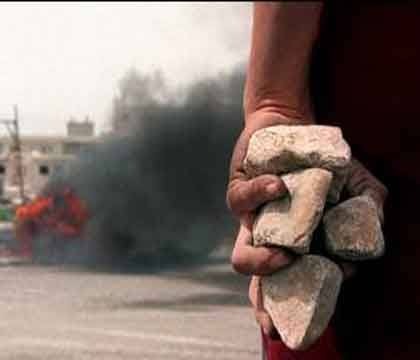
They dazzled the world— with nothing in their hands but stones. They shone like lanterns, came like good tidings. They resisted… exploded… fell as martyrs…
And we remained— polar bears, skins thick against the heat.
They fought for us, until they were slain. And we sat in our cafés— like spit inside a shell.
One of us searches for a trade, one begs for a new billion, a fourth wife, with breasts sculpted by civilization.
One hunts for a mansion in London, one trades in weapons, one drinks away his vengeance in bars, one dreams of throne, army, and emirate.
Ah— O generation of betrayals, generation of waste, generation of prostitution—
You shall be swept away— no matter how slow history may seem— by the children of the stones.
For the sake of remembrance, I would like to end this article with a poem by a martyred poet from Gaza. It is not, strictly speaking, a poem about resistance—but it reminds us why we need hope in our lives, even when everything feels bleak.
Not Just Passing by Hiba Abu Nada (translated by Huda Fakhreddine)
Yesterday, a star said to the little light in my heart, We are not mere passersby. Do not die. Beneath this glow some wanderers go on walking.
You were first created out of love, so carry nothing but love to those who are trembling.
One day, all gardens sprouted from our names, from what remained of the hearts of lovers.
Since the inception, this ancient language has taught us how to heal others with our yearning
how to be a heavenly sent to relax their tightening lungs: a welcome sigh, a gasp of oxygen.
Gently, we pass over wounds, like gauze, a hint of relief, an aspirin.
O little light in me, don’t die, even if all the galaxies of the world grew narrow… say: Enter my heart in peace. All of you, come in!
Interested in our work? Would you like to help us organize, write, or take part in solidarity efforts? We would be glad to have you join us at Tadamun. Resistance requires action.

 tadamun