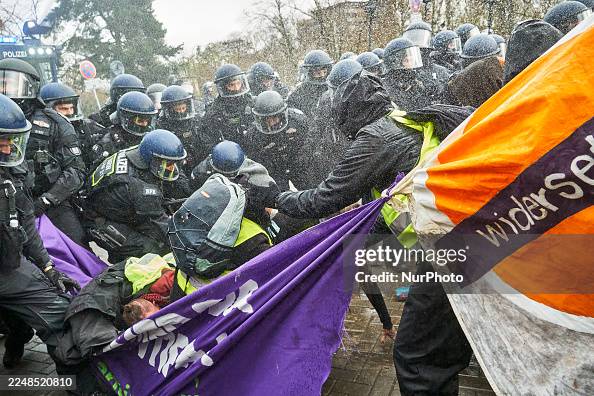
Am 29.11.25 folgten viele linke, Antifa- und Solidaritätsgruppen dem Aufruf von Widersetzen, gegen die Gründung der AfD-Jugend in Gießen zu protestieren. Die Demonstration wurde mit Polizeigewalt beantwortet. Dieser Beitrag argumentiert, dass der Kampf gegen den Faschismus notwendigerweise ein globaler und internationaler sein muss – sonst ist er zum Scheitern verurteilt. Er soll die Verbindungen zwischen unseren verschiedenen Kämpfen stärken und sichtbar machen, dass sie alle Teil desselben Kampfes sind.
“Sie haben diesen Nazismus geduldet, bevor er gegen sie selbst gerichtet wurde… weil er bis dahin nur auf nichteuropäische Völker angewandt worden war.”
Aimé Césaire, Über den Kolonialismus
Der Faschismus lässt sich nicht von Kolonialismus, Rassismus oder Kapitalismus trennen. In Deutschland nutzte der Faschismus dieselben Werkzeuge, die zuerst in Namibia eingesetzt wurden. Der Völkermord an den Herero und Nama ist das Modell, dem der Holocaust folgte. Der Genozid war der letzte Schritt eines faschistischen Projekts, das mit den Braunhemden begann, die jede Opposition sowie Minderheiten und Jüd:innen terrorisierten.
Wir sehen dieselbe Logik bis heute am Werk:
Im Sudan, wo die RSF Zivilist:innen terrorisiert, ihnen Häuser, Land und Eigentum nimmt und ein wirtschaftliches Imperium auf Gold- und Ölschmuggel sowie Menschenhandel aufgebaut hat.
In den USA, wo ICE Migrant:innen jagt, einsperrt und abschiebt, Menschen in Prekarität zwingt und so Superausbeutung und Niedriglöhne leichter durchsetzbar macht.
Im Westjordanland, wo Siedler:innen Palästinenser:innen angreifen, vertreiben und enteignen, sie durch jüdische Siedler:innen zu ersetzen versuchen und palästinensisches Land und Häuser in jüdisches Eigentum und Unternehmen verwandeln.
Wenn man die Gemeinsamkeiten zwischen diesen Bewegungen, den Nazi-Braunhemden und dem NS-Staat sieht, wird das Muster deutlich:
Zuerst wird eine Gruppe als „die Anderen“ definiert.
Dann werden ihr die Rechte genommen.
Dann nimmt man ihr Häuser, Löhne, Land und Zukunft.
Faschist:innen beginnen damit, das Eigentum und das Leben der Schwächsten und am stärksten Ausgesetzten zu zerstören: der Menschen am Rand der Gesellschaft, der „nicht Integrierten“, Migrant:innen, rassifizierten Menschen, Armen, queeren und trans Personen, Menschen mit Behinderung, Frauen und Menschen, die nicht in die Geschlechternormen passen.
Anstatt die Kapitalist:innenklasse anzugreifen, in der der Reichtum konzentriert ist, bietet der Faschismus dem Kapitalismus seinen hässlichsten Kompromiss an: In Zeiten der Krise ordnet er das System durch rassistische Gewalt neu – eine brutale „Jede:r gegen jede:n“-Umverteilung von unten, die den am stärksten Unterdrückten Häuser, Löhne, Land und Leben nimmt, während die Reichen unberührt bleiben.
Antifaschistisch zu sein bedeutet, sich dazu zu verpflichten, diese Bewegungen dort zu bekämpfen, wo sie zuerst zuschlagen: an den Rändern, bei denen, die durch Rassismus, Kolonialismus und Armut verwundbar gemacht werden.
In Deutschland richtet sich staatliche und polizeiliche Gewalt seit langem systematisch gegen Schwarze Menschen und People of Color. In den letzten zwei Jahren war die Palästina-Bewegung mit Verboten, Kriminalisierung und Polizeigewalt in einem bisher unbekannten Ausmaß konfrontiert. Dieselben Methoden werden jetzt gegen Antifaschist:innen und linke Bewegungen eingesetzt.
Unsere Kämpfe gegen Rassismus, gegen Zionismus, gegen Polizeigewalt und gegen Faschismus hängen alle zusammen.
“Ungerechtigkeit an irgendeinem Ort ist eine Bedrohung für die Gerechtigkeit überall.”
Martin Luther King Jr., Brief aus dem Gefängnis in Birmingham
Wir müssen für die Befreiung aller kämpfen, nicht nur für einige.
Den Kampf gegen die AfD kann man nicht trennen vom Kampf gegen die globalen Systeme, von denen sie lebt: Grenzen, Abschiebungen, Gefängnisse, Apartheid, Krieg, Überwachung und Ausbeutung.
Solidarität ist nicht nur ein Wort. Sie ist Handeln und eine langfristige Verpflichtung. Sie ist ein Kampf – kein „Whack-a-Mole“-Spiel, bei dem man Faschist:innen hinterherrennt, wo immer sie auftauchen, sondern ein Kampf darum, die Bedingungen anzugehen, die ihr Auftauchen überhaupt erst möglich machen.
Unsere Solidarität muss das Gegenteil von Faschismus und Kolonialismus sein: eine echte Verpflichtung zu globaler Gerechtigkeit, die konkret wird durch die Umverteilung von Reichtum und Macht – weg von Konzernen und Imperien, hin zu Communities, Arbeiter:innen und allen, die an den Rand gedrängt werden.
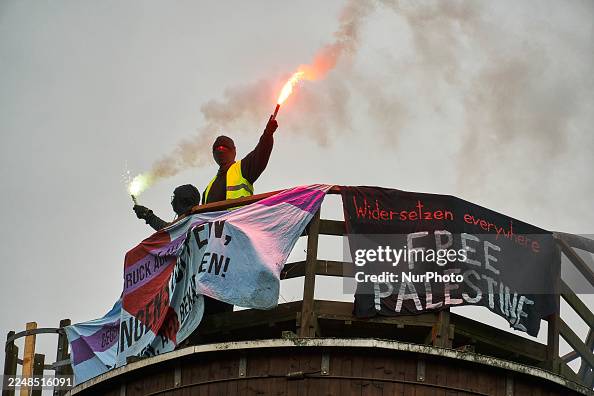
Eine Demonstrant:in steht mit Eine Demonstrant:in steht auf einer Baukonstruktion und hält Bengalos in Gießen, Deutschland, am 29. November 2025, während eines bundesweiten Aktionstags gegen den Neustart der Jugendorganisation der rechtsextremen AfD (Alternative für Deutschland). Zur Mobilisierung hatte das Bündnis „widersetzen“ aufgerufen. Mehr als 200 Busse und über 50.000 Demonstrierende aus ganz Deutschland kamen nach Gießen, um sich dem Neustart entgegenzustellen und ihn zu verhindern. Die Polizei reagierte mit einem Großeinsatz und setzte ein Maß an Gewalt ein, das in der linken Szene außerhalb der Palästina-Solidaritätsproteste bislang nicht zu sehen war. (Foto: Tonny Linke/NurPhoto via Getty Images)
On 29.11.25, many left, Antifa and solidarity groups followed the call by Widersetzen to protest the formation of the AfD youth in Gießen. The demonstration was met with police violence. This article argues that the struggle against fascism is necessarily global and international – otherwise it is doomed to fail. It aims to strengthen the connections between our different struggles and make visible that they belong to the same fight.
“They tolerated that Nazism before it was inflicted on them… because, until then, it had been applied only to non-European peoples.”
Aimé Césaire, Discourse on Colonialism
Fascism cannot be separated from colonialism, racism, or capitalism. In Germany, fascism used the same tools first deployed in Namibia. The genocide of the Herero and Nama is the model that the Holocaust followed. Genocide was the final step in a fascist project that began with the brownshirts, who terrorized any opposition as well as minorities and Jews.
We see the same logic at work today:
In Sudan, where the RSF terrorizes civilians and seizes their homes, land, and property, and has built an entrepreneurial empire on gold and oil smuggling and human trafficking.
In the USA, where ICE hunts, cages, and deports migrants, forcing people into precarity and making super-exploitation and low wages easier to enforce.
In the West Bank, where settlers attack, expel, and dispossess Palestinians, trying to replace them with Jewish settlers and turn Palestinian land and homes into Jewish property and enterprise.
Seeing the common ground between these movements and the Nazi brownshirts and Nazi state makes the pattern clear:
First define a group as “the other.”
Then strip them of rights.
Then take their homes, wages, land, and future.
Fascists start by liquidating the assets and lives of the weakest and most exposed: the people on the fringes, the “not integrated,” migrants, racialized people, the poor, queer and trans people, disabled people, women and gender-nonconforming people.
Instead of confronting the capitalist class, where wealth is concentrated, fascism offers capitalism its ugliest compromise: in times of crisis it reorganizes the system through racist violence – a dog-eat-dog redistribution from below that strips the most oppressed of their homes, wages, land, and lives while the rich remain untouched.
Being antifascist means committing to fight these movements where they hit first: at the margins, against those made vulnerable by racism, colonialism, and poverty.
In Germany, state and police violence has systematically targeted Black people and people of color.
In the last two years, the Palestine movement has faced bans, criminalization, and police attacks on an unprecedented scale.
The same methods are now used against antifascists and left movements.
Our struggles against racism, against Zionism, against police violence, and against fascism are all connected.
“Injustice anywhere is a threat to justice everywhere.”
Martin Luther King Jr., Letter from Birmingham Jail
We have to fight for liberation for all, not for some.
Fighting the AfD cannot be separated from fighting the global systems it feeds on: borders, deportations, prisons, apartheid, war, surveillance, and exploitation.
Solidarity is not just a word. It is action and long-term commitment. It is a struggle – not a game of whack-a-mole, chasing fascists wherever they pop up, but a fight to confront the conditions that allow them to emerge in the first place.
Instead our solidarity has to be the opposite of fascism and colonialism: a real commitment to global justice, made concrete through the redistribution of wealth and power—away from corporations and empires, toward communities, workers, and all who are pushed to the margins.
A protester stands on a construction structure holding flares in Giessen, Germany, on November 29, 2025, during a nationwide day of mobilization against the relaunch of the youth organization of the far-right AfD (Alternative für Deutschland). The alliance widersetzen had called for the mobilization. More than 200 buses and over 50,000 protesters from across Germany arrived in Giessen to oppose and prevent the relaunch. Police responded with a major deployment and used a level of force not seen in the leftist scene outside of Palestine-solidarity protests. (Photo by Tonny Linke/NurPhoto via Getty Images)
Robin D.G. Kelley — “The Black Radical Tradition Against Fascism and Genocide: The Long Durée” (UMass Amherst, April 3, 2025)
Die für eine der Solidarität verpflichteten Bewegung teilweise unerträgliche Kritik an unseren Kolleginnen von der Histadrut auch in gewerkschaftlichen Bünden verurteilen wir scharf. Nirgendwo anders werden Gewerkschaften mit dem Handeln ihrer Regierung gleichgesetzt und dafür verantwortlich gemacht. Die Histadrut steht immer wieder an der Spitze von Protesten gegen die israelische Regierung und setzt sich für ein friedliches Miteinander und den Austausch zwischen allen Beschäftigten ein.
In English:
We sharply condemn the at times unbearable criticism of our colleagues from the Histadrut, even within trade union federations, which claim to be committed to solidarity. Nowhere else are trade unions equated with the actions of their government and held responsible for them. The Histadrut has repeatedly been at the forefront of protests against the Israeli government and advocates for peaceful coexistence and exchange among all workers.
Taking a step back: why is the Histadrut subject to criticism at all? This article addresses that question by examining the Histadrut’s role, practices, political positioning, and its role in Israeli the war machine. On this basis, it argues that criticism is not only well-founded but necessary. Moreover, if the DGB is genuinely committed to “peace in the Middle East,” it must fundamentally reassess—and ultimately sever—its partnership with the Histadrut.
Founded in December 1920, the Histadrut—the General Federation of Hebrew Workers in Palestine—was established to secure the economic foundations of the Zionist project. Its core mission was not simply to organize workers, but to create and protect a Jewish labor force by excluding Palestinian Arab labor from key sectors of the economy. Through the doctrine of avodah ivrit (“Hebrew labor”), the Histadrut turned labor organization into a mechanism of colonization, linking employment to national belonging and transforming the workplace into a frontier of settlement.
From the outset, the Histadrut was both a union and an employer, owning enterprises, land, and industries that advanced Zionist colonization. Its companies—most prominently Solel Boneh—constructed roads, military outposts, and settlements, embedding the federation in the material infrastructure of the emerging Jewish state. As a central pillar of the Yishuv’s economic system, the Histadrut coordinated with the Jewish Agency and other state-building organs to exclude Palestinian workers, dismantle mixed unions, and monopolize employment through Jewish-only cooperatives and hiring halls.
After 1948, the Histadrut’s dual role as labor federation and development agency deepened. It became one of Israel’s largest employers, controlling major industrial, construction, and financial firms under its holding company Hevrat HaOvdim. These enterprises built the new state’s infrastructure while entrenching a racially segmented labor market that privileged Jewish citizens and relegated Palestinians—whether citizens of Israel or residents of the occupied territories—to precarious, low-wage positions outside collective representation.
By 1967, this institutional model had merged seamlessly with Israel’s occupation regime, subordinating Palestinian labor to Israeli regulatory power. Histadrut-affiliated firms such as Solel Boneh and Bank Yahav extended their activities into settlements in the West Bank and annexed East Jerusalem, while Palestinian workers in these same areas remained unrepresented. The federation’s continued integration with the settlement economy made it a direct participant in the consolidation of occupation.
The Military Role of the Histadrut
The Histadrut anchors organized labor inside Israel’s military-industrial complex, chiefly through its Metal, Electrical and High-Tech Workers Union, which represents employees at Israel Aerospace Industries (IAI), Rafael Advanced Defense Systems, and Elbit Systems. These firms produce core war-fighting systems—IAI’s missiles, UAVs, and C2 platforms; Rafael’s air and missile-defense and precision munitions; and Elbit’s electro-optics and battlefield electronics—central to Israel’s genocide in Gaza.
In this capacity, the Histadrut does not merely coexist with Israel’s war economy; it enables and sustains it, ensuring that labor power remains fully mobilized in the service of Israel’s continuing assault on Gaza.
The DGB has never been blind to the Histadrut’s historic role in the colonization of palestine, or its role in the . In its brochure “50 Jahre Partnerschaftsabkommen zwischen DGB und Histadrut”, it notes that “the Histadrut was practically a ‘state within the state.’” The federation’s support for Israel’s labor movement was not merely symbolic but consistently material—especially at pivotal moments. During the 1967 Six-Day War, for example, the DGB purchased an additional 3 million DM in development-aid bonds (Israel Bonds), publicly expressing confidence in Israel’s survival and democracy.
As the DGB Youth explicitly stated in Motion E011 “Boykotte boykottieren”, they branded BDS “anti-Israeli,” reaffirmed a two-state line, and distanced themselves from cultural, political, scientific, and economic boycotts of Israel. In practice, that stance delegitimized a key non-violent accountability tool and helped sideline BDS in labor forums. Coupled with defending the Histadrut while Palestinian workers remain excluded, and with German industry’s ongoing ties to Israeli firms (including war- and settlement-linked sectors), this posture shields the institutions underpinning Israeli apartheid—criticizing only its most visible violence while leaving its foundations intact.
Conclusion
What began as a gesture of postwar reconciliation has long since turned into complicity with a colonial project. The DGB’s partnership with the Histadrut — an institution that functions not as a vehicle of workers’ liberation but as a pillar of Zionist state power — embodies a deep contradiction at the heart of German labor internationalism. The Histadrut has never been a neutral trade union. From its founding, it has operated as an instrument of Jewish settlement, exclusion, and militarization. It is part of the political and economic structure that sustains Israel’s apartheid regime and its war economy.
By bargaining for the well-being of soldiers and reservists, by stabilizing Israeli civil society amid war, repression, and global outrage, and through its silence on the ongoing Gaza genocide, the Histadrut actively reinforces the occupation and the colonial order it depends upon. It negotiates not for the emancipation of all workers, but for the maintenance of privilege within an ethno-national state. To continue cooperation with such an institution — while Palestinian workers remain dispossessed, unrepresented, and exploited — is to abandon the principle of class solidarity in favor of nationalist loyalty.
It simply goes against the very concept of international worker solidarity to stand with a colonial labor federation that denies labor rights to those under occupation. It is not enough to condemn “extremism” or criticize “individual settlers” while ignoring the systemic role of Zionism and the Histadrut in perpetuating Palestinian exclusion and dispossession. The struggle for justice demands a break with this complicity.
If the DGB is serious about its proclaimed commitment to peace, it must act accordingly. That means ending its partnership with the Histadrut, supporting the Boycott, Divestment, and Sanctions (BDS) movement, and exerting pressure on German industry to sever all ties with Israel’s military-industrial complex and companies profiting from occupation and settlement. This is not simply a suggestion — it is an imperative of international worker solidarity.
To remain silent or neutral in the face of colonial and genocidal violence is to side with the oppressor. True solidarity lies with the Palestinian working class — those whose land, labor, and lives have been stolen, and who continue to resist against overwhelming power. Breaking with the Histadrut would not betray the principles of labor internationalism — it would restore them, aligning the German labor movement with the global struggle for justice, liberation, equality, and decolonization, from the Jordan to the Mediterranean.
This article examines Elbit Systems through three interconnected lenses: its operational role in the occupation of Palestine, its partnerships and investments — particularly in Germany — and the growing impact of divestment campaigns and direct action by pro-Palestine activists. In doing so, it situates Elbit within the broader political economy of occupation, where military violence and corporate profit are mutually reinforcing.
From Occupation to Export
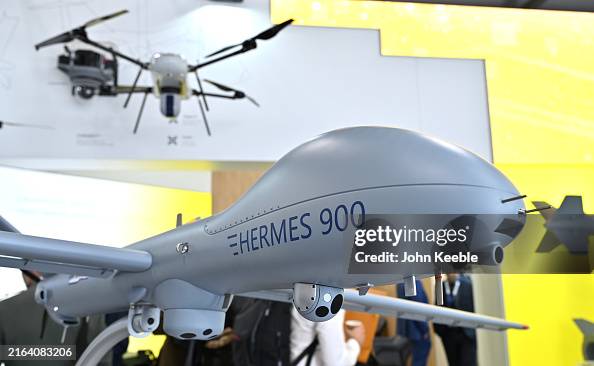
FARNBOROUGH, ENGLAND – JULY 23: A Hermes 900 Multi-role MALE UAS drone is displayed at the Elbit Systems exhibition stand during the Farnborough International Airshow 2024 at Farnborough International Exhibition and Conference Centre on July 23, 2024 in Farnborough, England. Farnborough International Airshow 2024 is host to leading innovators from the aerospace, aviation and defence industries. (Photo by John Keeble/Getty Images)
Elbit Systems Ltd., founded in 1966, is Israel’s largest private arms manufacturer and a central actor in the global defence industry. The company produces approximately 85 percent of the Israeli Defence Forces’ (IDF) land-based equipment and around 85 percent of its drones.1 This dominance has allowed Elbit to position itself as indispensable to Israel’s capacity to wage war and sustain its occupation of Palestinian territories.
Elbit’s product range covers unmanned aerial vehicles (UAVs), artillery systems, surveillance technologies, electronic warfare, and border monitoring infrastructure — much of which has been deployed during Israeli military operations in Gaza and across the occupied West Bank.2 These systems are often marketed as “battle-proven,” a euphemism that, in the Palestinian context, translates into “genocide-proven” — tested during operations that have caused mass civilian casualties, destruction of infrastructure, and forced displacement.3
Far from operating in isolation, Elbit is embedded in the global arms trade. The company maintains subsidiaries and joint ventures across multiple continents, including in Europe, North America, Latin America, and Asia.4 In Germany, Elbit has been involved in defence procurement, drone production, and joint research projects funded through EU frameworks, linking German state and industrial actors directly to the maintenance and expansion of Israel’s military capabilities.
In 2023, Elbit Systems secured multiple contracts across European markets, covering the PULS and ATMOS artillery systems, unmanned aerial vehicles, tank and mortar ammunition, XACT night-vision goggles, electronic warfare self-protection suites, counter-UAS systems, and other products. According to company executives, most of these systems are “highly relevant” to European defence needs and have all been “operationally proven” in the so-called Swords of Iron war (commonly referred to as the Gaza genocide). They emphasised that Elbit’s entire electronic warfare portfolio, precision-guided munitions, and unmanned systems were extensively deployed during the conflict with “very good results,” and argued that such combat use would strengthen interest from European buyers. The company noted that its sales and revenue from Europe have grown significantly in recent years.5
Additionally, Elbit Systems has benefited from significant European Union research funding through the Framework Programme 7 (2007–2013), Horizon 2020 (2014–2020), and Horizon Europe (2021–2027).6 Together, these programmes have channelled over €2.6 billion to Israeli entities, including major arms producers such as Elbit, Israel Aerospace Industries, and Rafael.7 Elbit’s involvement has included projects with German higher education institutions such as Technische Universität Braunschweig and Technische Universität Darmstadt under FP7, as well as participation in EU-funded security research initiatives focused on surveillance, border control, and law enforcement technology.8
In Germany, Elbit has been directly integrated into defense procurement and drone production, as well as joint research and development, connecting German state and industrial entities to the reinforcement of Israel’s military capabilities. Elbit won a $57 million contract to supply PULS rocket-launcher artillery systems to the German Armed Forces in collaboration with KNDS Deutschland, and has also secured a $260 million deal to provide DIRCM self-protection systems (J-MUSIC) for Germany’s Airbus A400M transport planes.910 Additionally, in a less formal but strategically aligned move, Lufthansa Technik has entered into a memorandum of understanding with Elbit Systems to deliver and maintain Hermes 900 Starliner military drones for the German Navy.11
Elbit Systems in the Occupation of Palestine
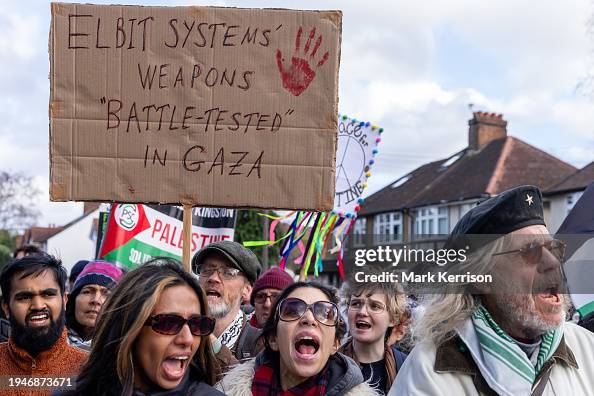
Pro-Palestinian activists protest against the International Armoured Vehicles Conference (IAVC) and the International Military Helicopter (IMH) Conference being held at Twickenham Stadium on 22nd January 2024 in Twickenham, United Kingdom. IAVC is currently taking place at the stadium and IMH is scheduled to take place in February. The events are attended by representatives of companies which supply weapons and military technology to Israel used against the Palestinians. (photo by Mark Kerrison/In Pictures via Getty Images)
Elbit’s dominant position was cemented in 2018 with the acquisition of Israeli Military Industries (IMI Systems), expanding its munitions, artillery, and electronic warfare capabilities.12 Ranked among the world’s largest arms companies, Elbit has a global footprint with subsidiaries and contracts in more than 50 countries — but its core business remains tied to the Israeli military and the occupation of Palestinian territories.13
Gaza: From “Battle-Proven” to “Genocide-Proven”
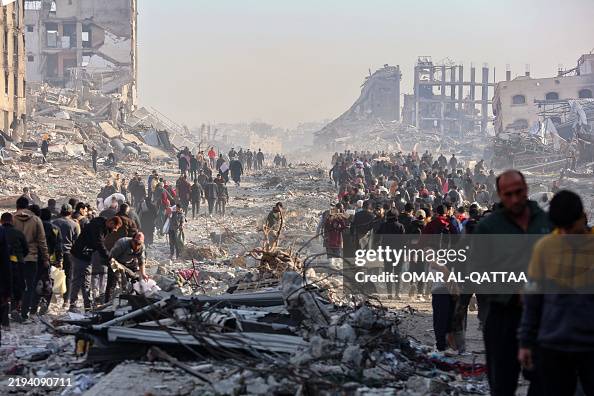
TOPSHOT – Scores of displaced Palestinians walk along a road in the Saftawi area of Jabalia, as they leave areas near Gaza City where they had taken refuge, toward the further northern part of the Gaza Strip, on January 19, 2025, shortly after a ceasefire deal in the war between Israel and the Palestinian militant group Hamas was expected to be implemented. The long-awaited ceasefire in the Israel-Hamas war was delayed January 19 after Prime Minister Benjamin Netanyahu said at the last minute that it would not take effect until the Palestinian militant group provided a list of the hostages to be released. (Photo by Omar AL-QATTAA / AFP) (Photo by OMAR AL-QATTAA/AFP via Getty Images)
Elbit weapons and surveillance systems have been deployed in every major Israeli assault on Gaza since at least 2008–2009 Operation Cast Lead), including Operation Protective Edge (2014), Operation Guardian of the Walls (2021), Operation Breaking Dawn (2022), and Operation Swords of Iron (2023–24).14 These campaigns have resulted in tens of thousands of Palestinian deaths — the majority civilians — and have been documented by UN bodies and human rights organisations as war crimes and, in the most recent case, the so called Operation Swords of Iron is a „possible“ genocide.15
A core feature of Elbit’s marketing strategy is to present its weapons as “combat-proven.” In the Palestinian context, this means “tested” during operations that deliberately target civilian infrastructure. Examples include the MPR 500 multi-purpose bomb, designed for “densely populated urban warfare” and used during assaults on Gaza,16 and the Hermes 450 and Hermes 900 drones, which make up the bulk of Israel’s UAV fleet. These drones are marketed internationally after repeated use in surveillance and targeted strikes in Gaza, including the April 2024 killing of seven World Central Kitchen aid workers in Deir al-Balah.17 In 2014, a Hermes 450 drone strike killed four children playing on a Gaza beach.18
World Central Kitchen cars were targeted in separate strikes: Al Jazeera Sanad probe
Elbit’s own corporate disclosures confirm that these assaults are not only facilitated by its technologies but also drive its business growth. In its 2024 year-end statement, the company reported a “material increased demand” for its products from the Israeli Ministry of Defense following the launch of Operation Swords of Iron in October 2023.19 Over the course of the year, Elbit secured contracts worth over $5 billion from the ministry, a dramatic rise compared to pre-war demand. The company explicitly acknowledged that continued military operations could generate “material additional orders,” tying its future revenues directly to the prolongation of the assault on Gaza.
To meet wartime demand, Elbit scaled up production, relocated manufacturing lines from areas under missile attack, recruited additional employees, and increased inventories.20 While these measures were presented as “support” for the Israeli military, they demonstrate the company’s active role in sustaining the assault through rapid delivery of weapons and surveillance systems. By integrating the war effort into its global operations — which continued largely uninterrupted — Elbit transformed the destruction of Gaza into shareholder value. This self-reported connection between military operations and profit underscores the company’s direct culpability in a campaign widely documented as involving well documented war crimes and genocide.
West Bank: Surveillance and Control
WEST BANK – NOVEMBER 10: View of a concrete security wall in Kalandia separating the West Bank city near Ramalla from East Jerusalem November 10, 2004. The huge concrete barrier Israel is putting up between Palestinian territories and Israel has split families that own property on both sides of the wall, in two. Israel says the barrier is necessary to stop suicide bombers while Palestinians call it a land grab. Ariel Sharon’s government plans to keep on building the barrier. (Photo by Shaul Schwarz/ Getty Images)
Elbit has been the primary provider of electronic detection systems and related surveillance technologies for Israel’s “smart walls,” as well as supplying technology for military checkpoints and armed ground vehicles used to patrol and control borders.21 Its involvement in Israel’s border surveillance industry dates back to 2002, when its subsidiary Ortek was awarded a $5 million contract to build a “smart” electronic barrier around part of Jerusalem, cutting off Palestinian residents from the rest of the West Bank. In 2006, Ortek received a further $17 million to deploy an electronic deterrence system — consisting of an electronic fence, communications systems, and computerised command and control posts — along segments of the separation wall.22
Elbit was also the main contractor for the “smart” sensors installed on Israel’s wall around the Gaza Strip, and in 2021 led the completion of an underground “smart wall” made up of hundreds of surveillance cameras, radars, and motion sensors.23 This project, begun in 2017, combined high-tech surveillance with physical fortification: 20-foot-tall aboveground barriers and reinforced slabs extending 130 feet underground. In addition, Elbit develops unmanned ground vehicles (UGVs) for border surveillance. In 2016, it introduced the Border Protector UGV — a Ford F-350 pickup equipped with autonomous driving technology and surveillance cameras — which was deployed along the Gaza border, replacing the earlier Guardium UGV co-developed with Israel Aerospace Industries.24 In 2022, Elbit unveiled the Medium Robotic Combat Vehicle (M-RCV), an armed robotic platform equipped with a gun turret, anti-tank missile launchers, and the capacity to deploy surveillance drones. Like its predecessors, it is expected to be deployed along Israel’s borders, including those with Gaza and the West Bank.25
Displacement and Militarised Land Grabs
NEGEV, ISRAEL – MAY 08: Israeli forces demolish 47 homes with heavy machines claiming they are ‚unlicensed‘ and leaving nearly 500 Bedoin Palestinians homeless at Nahal Hevron near Umm Batin village of Negev Desert, Israel on May 08, 2024. (Photo by Mostafa Alkharouf/Anadolu via Getty Images)
Elbit’s industrial expansion also contributes to the forced displacement of Palestinians. The relocation of the IMI Ramat HaSharon plant to Ramat Beka in the Naqab/Negev — part of a larger military-industrial zone plan — is expected to forcibly displace 36,000 Palestinian Bedouins, demolish over 2,000 buildings, and expose communities to long-term health risks.26
By embedding its products in both aerial warfare and systems of ground control, Elbit Systems has transformed the occupation itself into a proving ground for weapons — a process through which “battle-proven” becomes “genocide-proven.” This operational history has become a key selling point in the global arms market, sustaining Elbit’s growth while deepening the structures of Israel’s military rule over Palestinians.
German Partners in Genocide
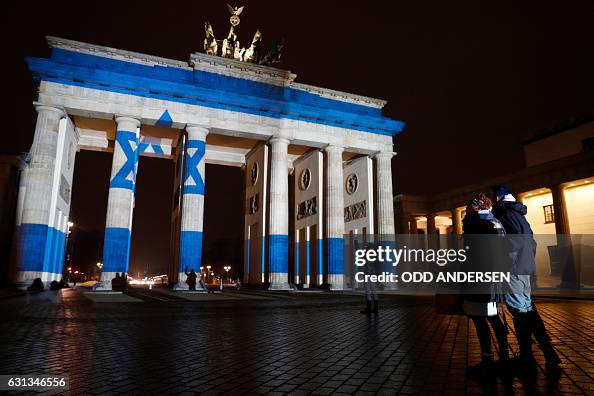
TOPSHOT – People look at the Brandenburg Gate with the Israeli flag projected onto in Berlin, on January 9, 2017. (Photo by Odd ANDERSEN / AFP) (Photo by ODD ANDERSEN/AFP via Getty Images)
Elbit Systems maintains a direct corporate presence in Germany through its subsidiary Elbit Systems Deutschland GmbH & Co. KG, headquartered in Ulm, Baden-Württemberg. This facility develops and produces electronic warfare systems, secure communication technologies, night vision equipment, and other military-grade components for the Bundeswehr and NATO partners.27 The Ulm site embeds Elbit into the German defence industrial base, granting it access to local supply chains, research institutions, and European defence procurement networks.
PLEASE WRITE US TO ADD FURTHER PARTNERS AND PRESSURE TARGETS!
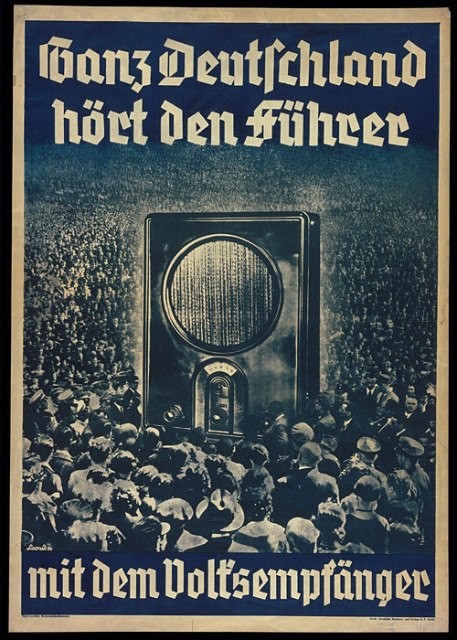
Telefunken – Elbit’s Ulm base was established through its 2011 acquisition of Telefunken Radio Communication Systems. Telefunken’s history includes supplying communications infrastructure during the Herero and Nama genocide in German South West Africa28 and producing military radios under the Nazi slogan “Ganz Deutschland hört den Führer mit dem Volksempfänger” (“All of Germany listens to the Führer with the Volksempfänger”).29 Its absorption into Elbit ties these legacies of state violence to present-day military occupation technologies.
1936 poster: „All of Germany Listens to the Führer with the People’s Radio.“ The poster depicts a crowd surrounding a radio. The radio looms large, symbolizing the mass appeal and broad audience for Nazi broadcasts. Bundesarchiv Koblenz (Plak003-022-025)30
Rheinmetall – Germany’s largest arms manufacturer — has collaborated with Elbit Systems on multiple projects, including the development and marketing of artillery and rocket systems such as the PULS (Precise & Universal Launching System) for European markets. This partnership integrates Elbit’s rocket artillery technology into Rheinmetall’s production and sales networks, directly linking the German arms industry to weapons systems tested and deployed by Israel in Gaza and the West Bank.31
Allianz – Allianz provides insurance coverage to Israeli arms manufacturers including Elbit, enabling production continuity during wartime and reducing operational risk.32
Jobrad – JobRad offers bicycle-leasing benefits to employees of Elbit Systems Deutschland, reflecting the company’s integration into German corporate networks.33
Northrop Grumman – Works with Elbit on advanced targeting systems, electronic warfare packages, and helmet-mounted display technology, with German aerospace programs benefiting indirectly through NATO-aligned contracts and Eurofighter upgrades.34
Horizon EU Funding – Through the EU’s Framework Programmes for Research and Innovation — specifically FP7, Horizon 2020, and Horizon Europe — Israeli entities, including Elbit Systems, have collectively received over €2.6 billion between 2007 and 2023, despite repeated calls from civil society to exclude Israeli military companies from these programmes due to their role in human rights violations in Palestine.35
Airbus – Airbus has partnered with Elbit Systems on military technology projects, including UAV integration and avionics systems, thereby embedding Elbit’s combat-tested technology into European aerospace production.36
Lufthansa – Lufthansa Technik, the maintenance arm of Lufthansa, is cooperating with Elbit Systems on a German Navy drone project involving up to eight Hermes 900 drones. The subsidiary is responsible for maintenance, repairs, and personnel training — a collaboration that indirectly legitimises a company central to Israel’s military operations in Gaza and the West Bank.37
Activism, Divestments and Challenges
European financial and institutional actors have not withdrawn from Elbit Systems out of goodwill or corporate conscience, but as a result of years of sustained grassroots pressure. Persistent campaigns, public shaming, shareholder interventions, and direct actions, have forced banks, pension funds, and other institutions in Germany, Europe, and beyond to confront their complicity in Elbit’s role in the occupation and genocide of Palestinians. These divestment decisions are less acts of moral awakening than reluctant concessions to organised resistance.
Activism
BDS and Civil Society Mobilisation – The global Boycott, Divestment, and Sanctions (BDS) movement has consistently named Elbit as a top target, exposing its role in Israel’s war crimes and pushing institutions to sever ties.
Palestine Action and Direct Disruption – In the UK, the “Shut Elbit Down” campaign — spearheaded by Palestine Action — has used sustained direct action, including blockades, rooftop occupations, and factory shutdowns, to physically disrupt Elbit’s operations and make its name synonymous with war profiteering. These tactics have inspired similar actions across Europe.
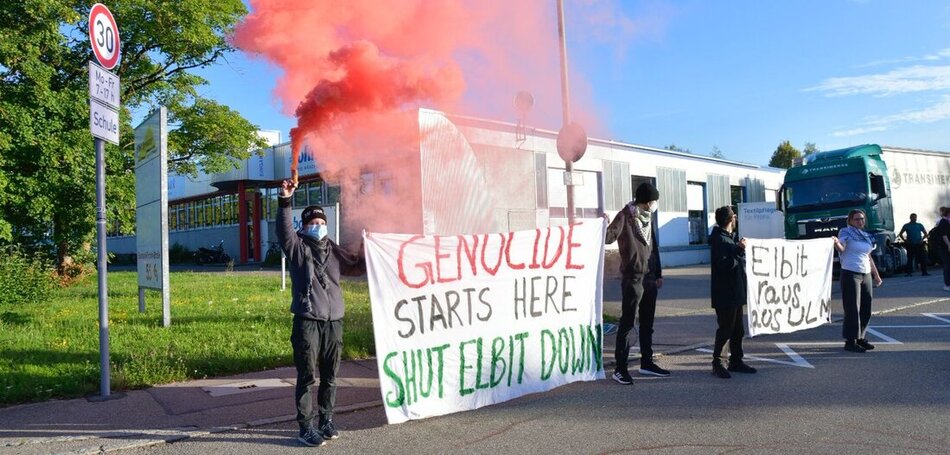
Shut Elbit Down in Ulm – Activists blockade Elbit Systems’ facility in Ulm as part of the Shut Elbit Down campaign, demanding the closure of all company sites in Germany over its role in genocide and apartheid. Protesters pointed to Ulm’s historical link to the White Rose resistance, urging the city to oppose hosting a “genocidal factory,” and cited UK campaigns that have already forced the closure of three Elbit sites.38
Blockade vor dem Standort der israelischen Rüstungsfirma Elbit Systems am Freitag in Ulm39
Through relentless organising, campaigners have raised the political cost of doing business with Elbit. Each divestment or contract cancellation is not a voluntary gesture, but the outcome of a public pressure campaign that refuses to let institutions hide their complicity.
Divestments
AXA – The French insurance giant fully divested from Elbit Systems by the end of 2019, following years of BDS-led campaigning, and removed investments from multiple Israeli banks by mid‑2024.40
iO Associates – A UK-based recruitment agency ended its cooperation with Elbit amid direct-action and campaign pressure.41
LaSalle Investment Management – Manager of the Shenstone UAV factory property in the UK, which terminated its lease with Elbit following protests and site disruptions.42
Deutsche Bank – In 2010, Germany’s largest bank officially announced the divestment of its approximately 2% holdings in Elbit Systems after sustained pressure from German human rights groups; although claims were mixed on whether those holdings were client-managed or proprietary, it set an important precedent.43
Challenges
In Germany, movement strategies targeting Elbit Systems face a uniquely complex political and cultural landscape:
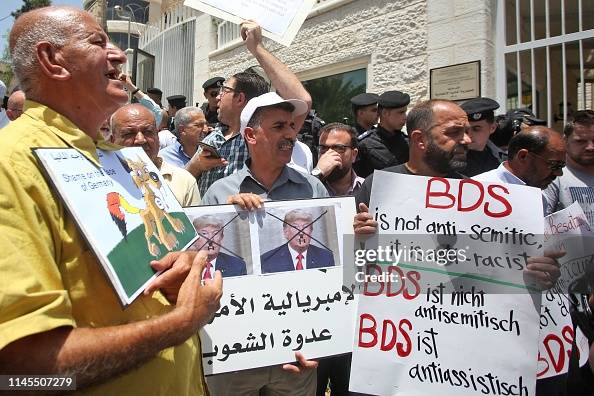
BDS and Accusations of Antisemitism: In 2019, the Bundestag passed a non-binding resolution declaring the Boycott, Divestment, and Sanctions (BDS) movement antisemitic.44 While this decision remains symbolic, it has been widely used by public institutions—universities, cultural venues, and city councils—to block funding, cancel events, and disinvite speakers associated with BDS.45 This institutionalization of antisemitism conflates legitimate human rights advocacy with hate speech, making public support for divestment campaigns politically risky.
Protesters stage a demonstration outside Germany’s Representative Office in Ramallah in the Palestinian West Bank on May 22, 2019, following the Bundestag’s (German parliament) condemnation of the Boycott, Divestment, Sanctions (BDS) movement as anti-Semitic. – Germany’s parliament condemned on May 17 the movement that demands a boycott of Israel as anti-Semitic, warning that its actions were reminiscent of the Nazis‘ campaign against Jews. (Photo by – / AFP) (Photo credit should read -/AFP via Getty Images)
Staatsräson and Historical Memory: The notion of Staatsräson—a constitutional-level commitment to Israel grounded in Germany’s Holocaust legacy—remains a foundational element of German foreign policy. From Angela Merkel’s affirmation to Olaf Scholz’s declaration that “Israel’s security is German Staatsräson,” this principle frequently overrides critical debate and reaffirms Israel as a perpetual ally.46 This narrative complicates activism by morally framing any criticism of Israeli policy as a challenge to German national identity and memory.
„Memory Culture“ as a Political Shield: Germany’s remembrance culture, with its innumerable memorials and educational initiatives, has become largely performative. Recent scholarship argues that it often serves to suppress contemporary critique of Israel, positioning any dissent as a betrayal of historical responsibility.47 Critics warn that such invocation of memory functions as a „manufactured unquestionability,“ effectively foreclosing meaningful dialogue and insulating policies and corporate actors—including Elbit and its German partners—from public scrutiny
Closing Words: Expanding the Struggle
The campaign against Elbit Systems in Germany is part of a growing international movement that recognises arms companies as central actors in the machinery of occupation and genocide. While direct actions, blockades, and public awareness campaigns have already put Elbit on the defensive, the next stage of activism must deepen roots in sectors with real economic leverage — especially organised labour. 48 German trade unions hold significant sway over procurement decisions, pension fund investments, and workplace policies that connect directly to Elbit’s German partners and supply chains. 49
Union-led campaigns could use existing frameworks for ethical procurement and socially responsible investment to push institutions, from municipalities to public banks, to sever ties with Elbit and similar companies.50 Linking the fight against the genocide in Gaza to the defence of workers’ rights in Germany not only widens the base of support but also reframes anti-militarism as a shared economic and moral cause.51
In this sense, the struggle against Elbit is not an isolated campaign, but part of a larger project: dismantling the economic, political, and ideological networks that sustain militarism, colonialism, and apartheid. From Ulm’s industrial zones to Germany’s boardrooms, and from European research funding programmes to the battlefields of Gaza, the challenge is the same — breaking the ties that make genocide profitable. The task ahead for activists in Germany is to continue building the coalitions that can achieve this: uniting Palestine solidarity groups, climate justice movements, and labour unions in a shared commitment to shut down the war machine at its source.
General Manager of Elbit Systems ISTAR & EW Division, Oren Sabag: „We’re honored to continue providing the IDF with our advanced self-protection and DIRCM solutions that enhance both safety and operational capabilities of their Black Hawk and Apache helicopters. Our track record of successful implementations worldwide demonstrates these systems‘ maturity and battlefield effectiveness. This contract further strengthens our strategic partnership with the Ministry of Defense and the IDF. It reflects our ongoing commitment to delivering technology that provides the highest level of protection for aircrews operating in hostile environments.“ https://www.linkedin.com/posts/israelimod_israel-mod-awards-55m-contract-to-elbit-activity-7330194304629403648-YUG-↩︎
Corporate Watch, Elbit Systems Company Profile, 2017 ↩︎
In 2023, Elbit secured contracts in the European markets for the PULS and ATMOS (Autonomous Truck Mounted Howitzer System), UAVs, tank ammunitions and mortar munitions, Xact goggles, EW self-protection suites, counter-UAS solutions, and more. „Most of our solutions are highly relevant to Europe and are operationally proven,“ Kril explained. „Our entire Electronic Warfare portfolio, precision guided munitions, unmanned systems, all of them have fully been operated substantially in the Iron Swords war (between Israel and Hamas) and demonstrated very good results. These are examples of products that we assume that the European market would be interested in as we have already sold these systems to many European countries and Elbit’s participation, revenue wise, has increased in the last couple of years.“ https://www.elbitsystems.com/blog/accelerating-operations-europe↩︎
The Israel Defense Force has an answer to the shelling yesterday that killed four children near the Gaza City port. At a media briefing yesterday, an IDF official reportedly said the attack had targeted an “identified Hamas structure,” and that Israeli forces had misidentified the boys as “fleeing fighters.” https://www.hrw.org/news/2014/07/17/dispatches-explaining-four-dead-boys-gaza-beach↩︎
The starting point is the history, largely unknown today, of the wireless radio link established by Telefunken in the German Reich between 1910 and 1914 between the large transmitter station Nauen (Brandenburg) via Kamina (Togo) to Windhoek (Namibia) and the use of radio technology in the genocide against the Herero and Nama in 1904. https://akono.de/product/from-windhoek-to-kamina-to-nauen-a-workbook-diverse-autorinnen-dt-eng-fr/↩︎
Rheinmetall and Elbit signed a cooperation agreement last year to develop, manufacture and market an automated European version, the companies said. The team is led by Rheinmetall Landsysteme GmbH. The companies showcased the system to other potential buyers and said that the UK’s Mobile Fires Platform program also remains a focus, and other would-be customers, such as Hungary, have expressed interest. https://www.defensenews.com/global/europe/2023/05/18/israels-elbit-looks-to-cash-in-on-european-artillery-appetites/↩︎
Zudem haben Sie die Möglichkeit, Ihr persönliches Wunsch-JobRad – mit oder ohne elektrischem Antrieb – bequem und günstig über uns zu beziehen. https://elbitsystems-de.com/karriere/↩︎
Deutsche Bank announces divestment from Israeli arms manufacturer Elbit Systems after campaign from German human rights organisations. Elbit Systems supplies Israeli military and provides components for Apartheid Wall ruled illegal by International Court of Justice. Deutsche Bank’s divestment follows similar steps by banks and pension funds in three Scandinavian countries. https://www.banktrack.org/news/deutsche_bank_announces_divestment_from_elbit↩︎
Wikipedia, Anti-BDS laws in Germany, accessed 2025. 74. The New Yorker, “In the Shadow of the Holocaust,” 2024. 75. Global Public Policy Institute (GPPi), “Germany must revisit its relationship with Israel,” June 2025. ↩︎
Wikipedia, Anti-antisemitism in Germany, accessed 2025. ↩︎




 tadamun