The German Trade Union Confederation (DGB) talks peace while backing rearmament and defending arms-industry jobs—this article maps the contradictions.
Background
Since Russia’s full-scale invasion of Ukraine in 2022, German politics has been marked by a sharp turn toward rearmament. The government’s €100-billion “Sondervermögen Bundeswehr,” NATO’s 2% spending target, and the EU’s ReArm Europe program all point to a new era of militarization. Trade unions, traditionally part of Germany’s peace movement, have been forced to position themselves in this landscape.
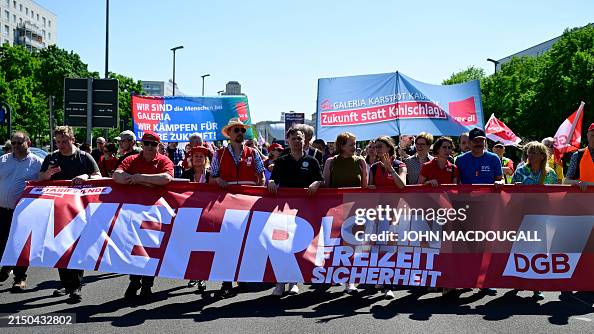
The German Trade Union Confederation (DGB) publicly continues to stress its commitment to peace, diplomacy, and disarmament. Its annual Antikriegstag statements, as well as the 2025 Easter March declaration, warn against a “spiral of blind militarization” and call for a broader understanding of security that includes diplomacy, crisis prevention, and social investment.
Yet at the same time, the DGB and its affiliates — especially IG Metall — are deeply entangled with the arms industry and have supported policy shifts that expand Germany’s military capacity. They endorse loosening the debt brake for defense, defend jobs in arms companies, and accept the logic of a stronger European military role.
The DGB presents itself as both a champion of social investment and a voice for peace. In its campaign against the debt brake, it warns that austerity is strangling the future:
“Die Schuldenbremse verhindert Investitionen in die öffentliche Infrastruktur und den Klimaschutz. Sie ist eine Zukunftsbremse für Deutschland.” (“The debt brake prevents investments in public infrastructure and climate protection. It is a brake on the future for Germany.” )
The unions demand nothing less than a fundamental reform:
“Wir fordern eine grundlegende Reform der Schuldenbremse, damit Deutschland die wichtigen Zukunftsaufgaben meistern und gleichwertige Lebensverhältnisse für alle schaffen kann.” (“We demand a fundamental reform of the debt brake so that Germany can master important future tasks and create equal living conditions for all.”)
Yet when it comes to defense, the language shifts. In its 2025 Easter March statement, the DGB simultaneously calls for “peace” while endorsing a build-up of Europe’s military capacity:
“Vor diesem Hintergrund sehen auch der DGB und seine Mitgliedsgewerkschaften die Notwendigkeit, in Deutschland und Europa verstärkte Anstrengungen zu unternehmen, um gemeinsam verteidigungsfähiger zu werden.” (“Against this background, the DGB and its member unions also see the need to make greater efforts in Germany and Europe to become more defense-capable together.”)
At the same time, the union federation warns of the dangers of militarization:
“Es wäre grundfalsch, damit in eine Spirale der blinden Militarisierung einzusteigen.” (“It would be fundamentally wrong to enter a spiral of blind militarization.”)
This dual stance highlights the contradiction: while opposing the debt brake for blocking social and climate investments, the DGB welcomes its loosening for military budgets — even as it insists it wants to “stop militarization.”
Partnership with the Arms Industry
The contradictions in the DGB’s position on militarization become clearest when looking at its largest affiliate, IG Metall, which organizes tens of thousands of workers in the arms sector.
A recent example is the conflict around LITEF in Freiburg, a company producing avionics systems used in both civilian and military applications. When peace activists criticized the firm as part of the war industry, IG Metall defended its members by insisting on the company’s civilian profile:
“LITEF produziert zivile Produkte – und genau deshalb ist es richtig, die Arbeitsplätze zu schützen.” (“LITEF produces civil products – and that is precisely why it is right to protect the jobs.” )
IG Metall Freiburg, Statement on the Antikriegstag controversy, RDL, 2019
At the same time, IG Metall openly celebrated securing 100 jobs at LITEF, emphasizing its role in protecting employment in the sector:
“Zusammen nötigen Druck aufgebaut … und 100 Arbeitsplätze bei LITEF gesichert.” (“Together we exerted the necessary pressure … and secured 100 jobs at LITEF.” )
These positions sit uneasily alongside DGB’s Antikriegstag declarations against rearmament and militarization. While unions issue statements condemning militarization, they simultaneously act as institutional guarantors of the arms industry’s workforce and production capacity.
The contradiction is even sharper when looking at IG Metall’s broader network: it organizes workers at Thyssenkrupp Marine Systems (submarines, warships), Rheinmetall (tanks, artillery, ammunition), and Airbus Defence & Space (combat aircraft, drones, satellite systems). These companies are pillars of the German and European arms industry — and IG Metall plays a key role in defending their jobs, production, and expansion plans.
In practice, this means the DGB’s peace rhetoric is consistently undercut by its function as a social partner in the arms economy. By protecting and institutionalizing jobs in weapons production, the unions help stabilize precisely the militarization that they claim to oppose.
Towards a True Working Class Solidarity
“Solidarity” cannot just mean protecting jobs in any sector, including those tied to war production. As long as unions remain bound to the government’s agenda—and the DGB has largely echoed state policy since its founding—the result is a narrow, national form of solidarity that stabilizes militarization rather than challenging it.
A true, internationalist working-class solidarity would require more: independence from the state, an extension of solidarity across borders to those who suffer under militarization, and the courage to connect workplace power with peace demands. Without this, union participation remains trapped in symbolism, repeating the pattern of the 1980s—loud in protest, but structurally aligned with the militarized status quo.
This article compares Histadrut (Israel), DGB (Germany), and NUMSA (South Africa) to show how unions navigate between state alignment and emancipatory solidarity. NUMSA practiced material leverage—sanctions, disinvestment, mass shop-floor action—while Histadrut built exclusionary labor regimes and the DGB favored regulation that softened boycotts. Read against Palestine today, the contrast is decisive: “codes of conduct” accommodate power, but disrupting profits and state strategy advances rights. The piece argues unions should center Palestinian unions’ demands and revive an internationalism grounded in enforceable pressure, not commemorative rhetoric.
I. Introduction: Labor Unions and Global Solidarity
Labor unions have historically been conceived as collective organizations designed to defend workers’ rights, improve working conditions, and embody the principle that “an injury to one is an injury to all.” Beyond the national arena, unions often present themselves as vehicles of international solidarity, linking workers’ struggles across borders against systems of exploitation, colonial domination, and authoritarian repression.1 Yet in practice, labor unions’ international engagements have been uneven, shaped not only by class struggle but also by nationalism, state power, and global geopolitical alignments.
This article examines three major labor federations: the Histadrut, the DGB, and NUMSA. Each represents a distinct historical trajectory and illustrates the broader tensions between solidarity and complicity.
The Histadrut (General Federation of Labor in the Land of Israel), founded in 1920 under the British Mandate, was unique among labor unions in that it functioned simultaneously as a union and as one of the largest employers in the country. It became integral to Zionist state-building, structuring a system of labor market exclusion that marginalized Palestinian workers while consolidating settler-colonial institutions.2
The Deutscher Gewerkschaftsbund (DGB), established in West Germany in 1949, consolidated most postwar German unions into a single umbrella federation. Built on the “social partnership” model of the Federal Republic, the DGB positioned itself as a stabilizing force for capitalist democracy and aligned closely with the West German state. Its approach to international relations was strongly conditioned by Cold War imperatives, often subordinating solidarity with workers abroad to the priorities of anti-communism and transatlantic loyalty.3
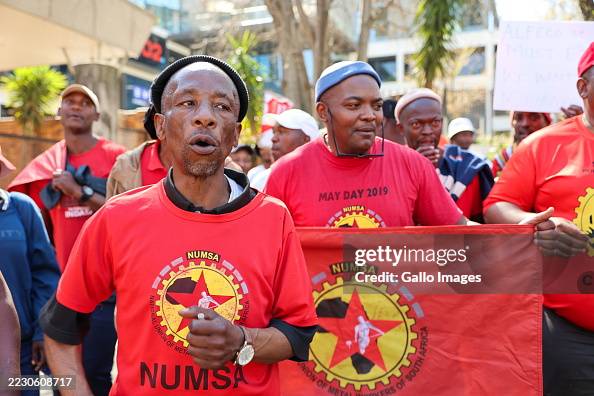
By contrast, the National Union of Metalworkers of South Africa (NUMSA), founded in 1987 through the merger of metal and engineering unions, quickly became one of the largest and most militant labor organizations on the African continent. Explicitly Marxist in orientation, NUMSA played a central role in the struggle against apartheid, linking economic exploitation to racial oppression and situating its politics within a broader anti-imperialist and internationalist framework.4
Taken together, these cases raise a central framing question: how have labor unions navigated the tension between international solidarity with oppressed peoples and loyalty to state power and capital? This inquiry is particularly urgent today, as contemporary struggles—most notably the Palestinian question—once again test the credibility of the labor movement’s universalist claims.
II. Apartheid and Labor Internationalism
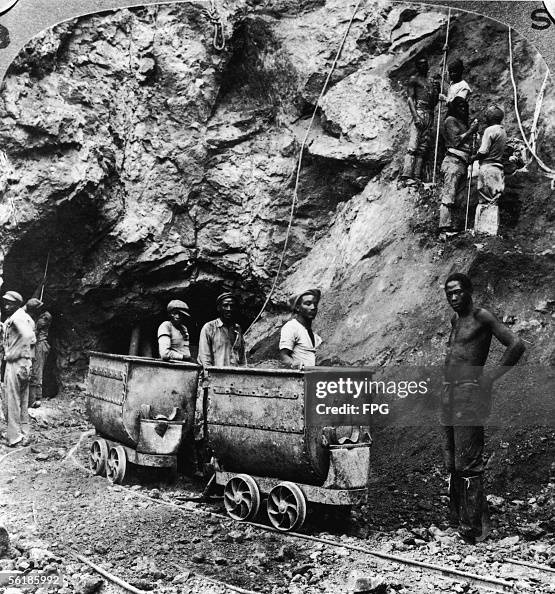
Miners stand by two mine cars on their track at one of the De Beers mines, Kimberley, South Africa, early 20th Century. (Photo by FPG/Getty IMages)
Apartheid in South Africa was a state-engineered system of racial domination built on the control and super-exploitation of Black labour: pass laws and migrant-labour compounds restricted movement and family life; job reservation and colour bars rationed skilled work; and strikes by African workers were criminalised for decades. Only after the 1979 Wiehahn reforms did the state begin to legally recognise Black trade unions—still under heavy registration controls—so even “reform” reproduced coercion in the workplace.5
Inside the country, unions were central to breaking apartheid’s labour order. The 1973 Durban strike wave ignited a modern, Black-led union movement that built shop-steward structures in strategic sectors; it coalesced into FOSATU (1979) and later COSATU (1985), linking plant-level struggles to township mobilisations and broader democratic fronts despite bannings and repression. This “from the shop floor up” organising made key workplaces ungovernable without conceding worker rights and turned labour into a national force against the regime. 6
Internationally, union power helped translate apartheid’s labour regime into a global target. Multilateral pressure mounted—from the UN’s mandatory arms embargo (UNSC 418, 1977) to U.S. economic sanctions (Comprehensive Anti-Apartheid Act, 1986)—while labour and anti-apartheid networks coordinated boycotts, disinvestment, and supply-chain actions. European governments promoted “codes of conduct” for firms operating in South Africa, improving some shop-floor conditions but also keeping many multinationals in place—highlighting the strategic split between regulation and rupture as COSATU/NUMSA and allies pressed for comprehensive sanctions. 78
i. Histadrut
The Histadrut in Israel developed significant and long-standing ties to the apartheid regime in South Africa, both as a labor federation and as an economic conglomerate. Although Israeli officials sometimes claimed that the Histadrut “refused to have any dealings with the South African regime,” in reality several of its enterprises were central to Israeli–South African economic relations. The most prominent case was the Histadrut-owned Koor Industries, which entered a 51 percent joint venture with the South African Steel Corporation to create Iskoor, a manufacturer of steel products including armor plating for tanks used by apartheid security forces.9 Similarly, the construction company Solel Boneh, another Histadrut enterprise, became active not only in South Africa but also in the Bantustans — the so-called “tribal reserves” that the apartheid state used as a cornerstone of racial segregation and dispossession. In supporting these institutions, the Histadrut and the Israeli Foreign Ministry acted as “open benefactors” of one of apartheid’s most notorious instruments of domination.10
This economic partnership was embedded in the broader convergence of Israel’s and South Africa’s settler-colonial projects. In 1948, the year of Israel’s establishment, South Africa’s Afrikaner-dominated National Party came to power and began codifying apartheid; despite the antisemitic history of many of its leaders, the National Party quickly adopted a pragmatic policy of supporting Israel and accommodating South Africa’s Jewish population.11 The relationship intensified after 1976, when Israeli Prime Minister Yitzhak Rabin and South African Prime Minister John Vorster signed agreements that expanded military and industrial cooperation. A particularly sensitive dimension was nuclear collaboration, in which Israel provided technical expertise in exchange for South African uranium and access to open spaces for weapons testing; the infamous 1979 “double flash” in the South Atlantic was widely understood as the result of this cooperation.12
Taken together, this record shows that the Histadrut functioned less as a vehicle of worker solidarity than as an institution embedded in, and servicing, a racialized labor order—most clearly in South Africa. Through its conglomerates, it was not a passive shareholder but an active partner in apartheid’s war-economy and “separate development”: Koor/Iskoor supplied strategic steel, including armor plate, and Solel Boneh took contracts in the Bantustans, lending material capacity and political legitimacy to one of apartheid’s core instruments of control.13
These ties helped cushion the regime against growing isolation and undercut the impact of sanctions and disinvestment campaigns led by the ANC and COSATU. Seen in this light, the Histadrut’s role in South Africa was an external extension of the same institutional logic it honed at home—Zionism’s “conquest of labor,” Hebrew-only employment, and tight state–capital–union entanglements that organized the settler workforce while excluding colonized labor. Framed within contemporary legal analysis of apartheid as a system of institutionalized domination, the Histadrut’s South African ventures appear continuous with its colonizing project in Palestine, standing as a stark counterpoint to any claim that it represented universal worker solidarity.14
ii. DGB
The Deutscher Gewerkschaftsbund (DGB) occupied a contradictory position during the struggle against apartheid. Within its ranks, IG Metall, the powerful German metalworkers’ union, played the most active role in South Africa. In the late 1970s and 1980s, IG Metall established direct relations with black trade unions at the Volkswagen plant in Uitenhage, where many militant workers later joined NUMSA. Through these contacts, the union helped develop the “Minimum Standards” agreement, a set of 14 points adopted in 1987 that addressed wages, health and safety, union recognition, and workplace segregation. The adoption of Minimum Standards represented a significant intervention: it strengthened the position of NUMSA in German-owned plants, forced companies like Volkswagen to acknowledge black unions, and created mechanisms to circumvent restrictions imposed by South Africa’s labor relations system.15
Yet the policy also reflected ambivalence. By negotiating codes of conduct for German firms rather than pushing for outright withdrawal, IG Metall and the DGB avoided costly disinvestment that might have led to job losses in both South Africa and Germany. This raised the question of whether such agreements undermined the international sanctions and disinvestment campaigns spearheaded by the African National Congress (ANC) and COSATU. NUMSA officials who negotiated the Minimum Standards sought to resolve the tension by insisting that the code was not a substitute for sanctions, but rather a tool to secure immediate gains for black workers while remaining fully committed to COSATU’s policy of comprehensive disinvestment.16
In retrospect, the ambivalence of IG Metall’s approach becomes clearer when placed against the backdrop of West German business interests in South Africa. While the union sought to improve conditions for black workers through Minimum Standards, German corporations deepened their ties to the apartheid regime at the very moment when US companies were divesting.17 The arms industry even violated the UN embargo, with firms such as Daimler-Benz described as “vital partners” of South Africa’s war machine.18 That these same corporations now face lawsuits for supporting apartheid crimes underscores the limits of a purely reformist strategy.19 IG Metall’s initiatives brought tangible gains on the shop floor, but they coexisted with a wider pattern of German economic collaboration that blunted the impact of international sanctions and raised enduring questions about the boundaries of solidarity.
iii. NUMSA
NUMSA was a cornerstone of the anti-apartheid fight in the strategic auto and metal sectors: founded in May 1987 through a merger of metal and motor unions, it built dense, black-led shop-steward structures that turned wage, safety, and grading disputes into mass leverage against employers and the state. 2021 Anchored in COSATU, it linked factory struggles to township stay-aways and national defiance, helping make production “ungovernable” without conceding worker rights. 22 Internationally, NUMSA pressed for sanctions and disinvestment—insisting that codes of conduct could not substitute for material pressure—while coordinating with allies in global auto supply chains (notably around Volkswagen’s Uitenhage plant). 23 Scholars have captured this orientation as “social-movement unionism”: a fusion of shop-floor power and community mobilization that treated workplace victories as part of a broader project to dismantle racial-capitalist rule. 24
iv. Remarks
JOHANNESBURG, SOUTH AFRICA: Supporters of South Africa’s African National Congress (ANC), wearing on their sleeves the colors of their party, gather 12 August 1952 in Johannesburg as part of a civil disobedience campaign to protest the apartheid regime of racial segregation. The protesters were later arrested. (Photo credit should read AFP via Getty Images)
In sum, the record reveals a sharp divergence in labor internationalism. NUMSA treated unions as instruments of liberation—pressing for sanctions and disinvestment—while the Histadrut, through enterprises like Koor/Iskoor and Solel Boneh, materially serviced apartheid’s political economy. IG Metall’s Minimum Standards fit uneasily between these poles: they delivered tangible shop-floor gains and, as NUMSA emphasized, were never meant to replace sanctions, yet in practice they helped German firms remain in South Africa and thereby softened the bite of the broader boycott. The DGB’s and IG Metall’s choice to regulate rather than rupture reflects a strategic ambivalence—stabilizing employment and corporate operations even as the ANC/COSATU campaign sought to isolate the regime. The contrast is instructive: solidarity measured by codes of conduct tends to accommodate power, whereas solidarity measured by the willingness to disrupt profits and state strategy aligns with emancipatory struggle.
III. Palestine and the Question of Solidarity
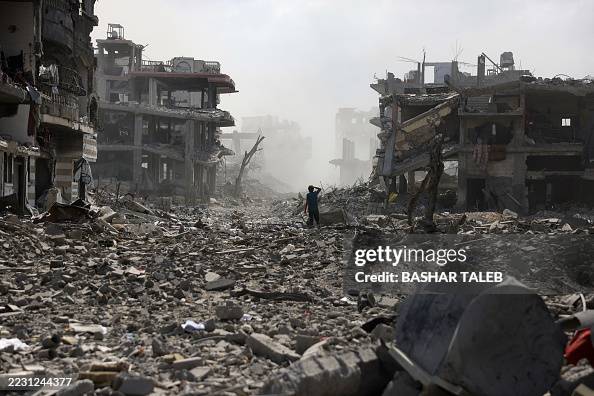
TOPSHOT – A Palestinian youth stands on a street strewn with rubble following an explosion in the Saftawi neighbourhood, west of Jabalia in the northern Gaza Strip on August 25, 2025. Israeli Defence Minister Israel Katz vowed on August 22, to destroy Gaza City if Hamas did not agree to disarm, release all remaining hostages in the territory and end the „war“ on Israel’s terms. (Photo by BASHAR TALEB / AFP) (Photo by BASHAR TALEB/AFP via Getty Images)
Palestine concentrates the central dilemmas of labor internationalism in a concrete labor regime. Historically, the Zionist labor movement organized the “conquest of labour,” promoting Hebrew-only employment and institutional links between state, capital, and the dominant union—foundations that structured later relations with Palestinian workers.25 A permit and surveillance apparatus has governed Palestinian access to Israeli labor markets, producing dependence, precarity, and selective incorporation without equal civic or industrial rights.26 The broader political economy—marked by de-development in Gaza, subcontracting and outsourcing across the West Bank, and the entanglement of “ordinary” commerce with settlement infrastructure and security industries—has fragmented workforces while normalizing business ties to occupation.27 The Oslo era did not resolve these contradictions; rather, it codified an “imposed integration” that kept Palestinian labor subordinate to Israeli regulatory, fiscal, and spatial power.28
Against this backdrop, the next three subsections examine how major labor actors position themselves vis-à-vis Palestine: the Histadrut (its historic role in exclusion and settlement integration), the DGB (partnership diplomacy framed as reconciliation, and its silences on occupation), and NUMSA (an explicitly anti-colonial internationalism aligning with boycott, divestment, and sanctions). The question throughout is whether unions mobilize their transnational power to confront systems of domination—or default to national and corporate alignments when principles meet geopolitical constraint.
i. Histadrut
JERUSALEM:David Gryn, better known as David Ben-Gurion, in file picture dated 1948. Ben-Gurion, the Israeli first Prime Minister who signed the proclamation of Israel’s creation on 14 May 1948, was born in Plonsk (Poland) 16 October 1886. Zionist, he immigrated to Palestine in September 1906. Young socialist farmer, Ben-Gurion founded in 1919 a labour party, Mapai and in 1922 the first trade union, Histadrut. (Photo credit should read AFP via Getty Images)
From the late nineteenth century into the Mandate era, a European idea of Jewish “productivization” was translated onto colonial ground as the conquest of labor (avodah ivrit): employment policy became an instrument of nation-building through the organized exclusion of Palestinian Arab workers. Read through Patrick Wolfe’s thesis—settler colonialism as a structure that seeks the elimination and replacement of the native—this was not a marginal tactic but a constitutive technology of rule. In Palestine, the imperative was to create a Jewish workforce for a Jewish economy, even when this ran against market efficiency.29
Empirically, early plantation and settlement economies experimented with a tiered labour market—higher-priced Jewish labour alongside lower-priced Palestinian labour—but Jewish employers could not compete with the skills and subsistence base of Palestinian peasants. The result, as Gershon Shafir and Michael Burawoy both emphasize, was a strategic move toward exclusion: the consolidation of cooperatives such as the kibbutzim, and, in December 1920, the founding of the Histadrut to fence off jobs, organize hiring, and embed Hebrew labour across sectors.3031
Across the Mandate and into statehood after 1948, the Histadrut fused union, employer, and developmental roles. Its enterprises—most notably Solel Boneh—built core infrastructures while entrenching segmented labour markets that privileged Jews and marginalized Palestinians. By the time Israel occupied the West Bank and Gaza in 1967, this institutional pattern meshed with a territorial regime that subordinated Palestinian workers to Israeli regulatory power and settlement expansion. As trade-union advocates later summarized, the Histadrut’s record includes dismantling mixed unions, discriminating against Palestinian workers, and intertwining its firms with the settlement project (e.g., Solel Boneh’s settlement construction; Bank Yahav’s operations in annexed East Jerusalem and West Bank settlements; membership extended to settlers while their Palestinian neighbours remained excluded). These practices underpinned Palestinian trade-union calls for international labour to boycott the Histadrut until it ended complicity and recognized Palestinian workers’ rights.32
Internationally, Israel’s Labour-Zionist institutions also forged partnerships that reflected this internal logic. As Jane Hunter documents, Histadrut-owned conglomerates such as Koor took a controlling stake in the Iskoor venture with the South African Steel Corporation, while Solel Boneh worked in the Bantustans—arrangements that echo the racialized segmentation at home and show how a colonizing labour regime could be externalized. Antony Loewenstein’s account of the broader Israeli–South African relationship in the 1970s underscores the strategic, not merely commercial, character of these ties—context that helps explain why Palestinian unions later framed their struggle within an anti-apartheid, anti-colonial horizon.3334
In the present, this institutional orientation remains visible in the Histadrut’s public positioning. Its 2011 critics drew a straight line from Mandate-era exclusion to contemporary complicity in occupation; legal analysis by John Dugard and John Reynolds situates the ongoing system as one of institutionalized domination that meets the international-law threshold of apartheid. Against rising union solidarity with Palestine, the Histadrut’s August 2025 statement reframes settlement-trade bans and related measures as “selective” or “partisan,” recoding rights-based accountability as bias and urging a depoliticized “consistency” that leaves the material structures of domination intact. The through-line, from conquest of labour to today’s diplomacy, is labour power mobilized to build and shield a settler project—and a counter-current in international unionism insisting that effective solidarity requires material pressure, not managed engagement.353637
For over fifty years, the DGB and the Histadrut have cultivated a celebrated partnership—formalized in 1975 and publicly renewed in April 2025 with speeches, awards, and plans for further cooperation. Framed by remembrance and youth exchange, this history shapes a public posture that leans on universalist language about “peace,” “democracy,” and “diversity” while eliding occupation, settlement expansion, and Palestinian workers’ rights; the DGB’s October 2023 letter to the Histadrut exemplifies that register, invoking Nie wieder, praising essential workers, and welcoming Berlin’s “unconditional support,” but naming none of the structural asymmetries Palestinians face. 3839
The pattern was underscored by the February 2025 delegation: a wreath-laying at Yad Vashem—“otherwise reserved for heads of state”—a meeting with President Isaac Herzog, and announced talks with Histadrut leadership, all presented as continuity rather than rights-based scrutiny of labor under occupation. This embrace came even as the International Criminal Court had issued arrest warrants for sitting members of Israel’s government (Benjamin Netanyahu and Yoav Gallant); yet there was no hesitation to meet Israel’s president.4041
That stance dovetails with Histadrut’s August 2025 argument that measures like settlement-trade bans “single out” Israel and risk making unions “partisan”—a reframing that casts accountability tools (boycott, divestment, targeted trade measures) as bias. Falling in line with that narrative also fits Germany’s climate, where BDS is already institutionally shunned: the Bundestag’s 2019 resolution—and subsequent reaffirmations—urge withholding public funding and space from groups backing BDS. The effect is to normalize a status quo from which Palestinian workers derive few enforceable rights, while the DGB’s preferred “engagement and balance” tracks state priorities more than it advances internationalist solidarity. 424344
iii. NUMSA
SOWETO, SOUTH AFRICA – JUNE 21: Mural at the first ever solidarity walk for Palestine on June 21, 2025 in Soweto, South Africa. The group is calling for the promotion of Palestinian people human rights, self-determination, and an end to the Israeli occupation of Palestinian territories. (Photo by Fani Mahuntsi/Gallo Images via Getty Images)
NUMSA frames Palestine through the lens of South Africa’s own anti-apartheid struggle, explicitly naming Israel an apartheid state and endorsing boycott, divestment, and sanctions as unions’ proper instruments of solidarity. In statements over the last decade, the union has backed BDS and urged allied movements “on the continent and around the world” to do the same; during earlier assaults on Gaza it coupled that stance with calls for diplomatic rupture, including expelling the Israeli ambassador.45
In the current cycle, NUMSA has pressed for concrete state action: sanctions on Israel, the severing of diplomatic ties, and a permanent ceasefire—positioning these demands as the logical extension of South Africa’s historical experience with international pressure against apartheid. It has also reiterated solidarity language that centers Palestinian rights and accountability for Israeli state violence. These commitments appear consistently in NUMSA’s public communiqués and campaigns across 2023–2025. 46
Beyond statements, NUMSA has worked to translate solidarity into trade-union praxis: advancing motions in international union fora, encouraging workers to resist complicity in the logistics of war, and aligning with calls to escalate targeted economic measures until Palestinian rights are realized. In this register, Palestine is not an abstract “conflict” to be neutrally managed but a living test of labor’s willingness to deploy disruptive power against a system identified—by South African unionists themselves—as apartheid. 4748
iv. Remarks
In closing, the roles are stark: the Histadrut functions as a gatekeeper that recodes rights-based pressure (BDS, settlement-trade bans, conditionality) as “partisanship,” the DGB largely mirrors that register through ceremonial partnership and “engagement and balance,” and NUMSA models a different labor internationalism grounded in material leverage—sanctions, divestment, procurement exclusions, and arms embargoes—rooted in an anti-apartheid tradition. If solidarity with Palestine is to mean more than symbolism, unions should center Palestinian unions’ demands, make any cooperation with the Histadrut contingent on clear rights benchmarks (ending complicity in settlements, defending Palestinian workers’ organizing and mobility), and adopt enforceable measures rather than neutral language that treats an unequal regime as a conflict between equals.
IV. Conclusion: Lessons for Today
BETHLEHEM, PALESTINE – 2018/02/12: Nelson Mandela drawing seen on the separation wall in Bethlehem. (Photo by Jana Cavojska/SOPA Images/LightRocket via Getty Images)
International solidarity is a practice, not a posture. Read across a century of labor politics, the contrast is instructive: Histadrut and, in Germany, the DGB show how unions can be folded into state priorities and remembrance rituals that depoliticize structural domination; NUMSA shows that labor can still act as a protagonist of emancipation. Palestine is today’s touchstone. To meet it honestly, unions must move from symbolism to leverage: center Palestinian trade-union demands, condition relations with Israeli institutions on enforceable rights benchmarks, and adopt concrete measures—settlement-trade bans, divestment, procurement exclusions, and arms embargoes—alongside shop-floor organizing and cross-border coordination. The record is clear in miniature: NUMSA wielded sanctions and disinvestment; the Histadrut materially serviced apartheid through corporate ventures; IG Metall’s “Minimum Standards” won workplace gains yet kept firms in place and softened boycotts; and the DGB/IG Metall choice to regulate rather than rupture exemplified the limits of managerial “engagement.”
Returning to labor’s emancipatory core—“an injury to one is an injury to all”—means refusing neutrality between unequal parties. It means aligning international work with universal worker rights rather than national alignments, and treating anti-racism at home and anti-colonialism abroad as one struggle. Solidarity measured by codes of conduct tends to accommodate power; solidarity measured by a willingness to disrupt profits and state strategy aligns with emancipatory struggle. Anything less is commemoration without consequence.
“If you are neutral in situations of injustice, you have chosen the side of the oppressor.” — Desmond Tutu
V. Footnotes
Silver, B. J. (2003). Forces of Labor: Workers’ Movements and Globalization since 1870. Cambridge University Press. ↩︎
Shafir, Gershon. Land, Labor and the Origins of the Israeli-Palestinian Conflict, 1882–1914. ↩︎
Dribbusch, H., & Birke, P. (2011). Gewerkschaften in der Bundesrepublik Deutschland. Bundeszentrale für politische Bildung. ↩︎



 tadamun