
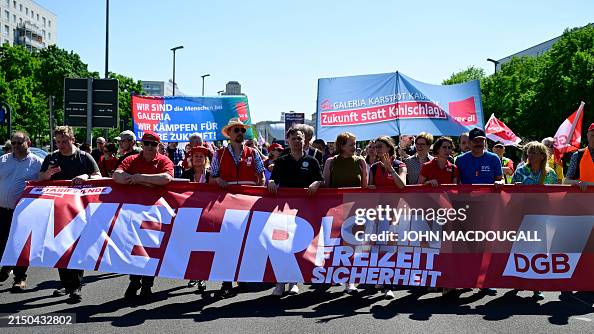
The DGB maintains an exceptionally close relationship with the Israeli trade union federation Histadrut. Mutual visits, seminars, workshops, and regular exchanges continue, and new partnerships between regional branches of the Histadrut and the DGB are still being forged. Within the DGB itself, this is often described as its deepest and most enduring international trade-union partnership, stretching more than 50 years.
In the DGB’s July 2025 statement, “Die Gewalt in Gaza beenden – jetzt!”, the DGB defended this partnership, writing:
In german:
Die für eine der Solidarität verpflichteten Bewegung teilweise unerträgliche Kritik an unseren Kolleginnen von der Histadrut auch in gewerkschaftlichen Bünden verurteilen wir scharf. Nirgendwo anders werden Gewerkschaften mit dem Handeln ihrer Regierung gleichgesetzt und dafür verantwortlich gemacht. Die Histadrut steht immer wieder an der Spitze von Protesten gegen die israelische Regierung und setzt sich für ein friedliches Miteinander und den Austausch zwischen allen Beschäftigten ein.
In English:
We sharply condemn the at times unbearable criticism of our colleagues from the Histadrut, even within trade union federations, which claim to be committed to solidarity. Nowhere else are trade unions equated with the actions of their government and held responsible for them. The Histadrut has repeatedly been at the forefront of protests against the Israeli government and advocates for peaceful coexistence and exchange among all workers.
Taking a step back: why is the Histadrut subject to criticism at all? This article addresses that question by examining the Histadrut’s role, practices, political positioning, and its role in Israeli the war machine. On this basis, it argues that criticism is not only well-founded but necessary. Moreover, if the DGB is genuinely committed to “peace in the Middle East,” it must fundamentally reassess—and ultimately sever—its partnership with the Histadrut.
The Settler-Colonial Role of the Histadrut
(Refer the article: Labor, Apartheid and Israel)
Founded in December 1920, the Histadrut—the General Federation of Hebrew Workers in Palestine—was established to secure the economic foundations of the Zionist project. Its core mission was not simply to organize workers, but to create and protect a Jewish labor force by excluding Palestinian Arab labor from key sectors of the economy. Through the doctrine of avodah ivrit (“Hebrew labor”), the Histadrut turned labor organization into a mechanism of colonization, linking employment to national belonging and transforming the workplace into a frontier of settlement.
From the outset, the Histadrut was both a union and an employer, owning enterprises, land, and industries that advanced Zionist colonization. Its companies—most prominently Solel Boneh—constructed roads, military outposts, and settlements, embedding the federation in the material infrastructure of the emerging Jewish state. As a central pillar of the Yishuv’s economic system, the Histadrut coordinated with the Jewish Agency and other state-building organs to exclude Palestinian workers, dismantle mixed unions, and monopolize employment through Jewish-only cooperatives and hiring halls.
After 1948, the Histadrut’s dual role as labor federation and development agency deepened. It became one of Israel’s largest employers, controlling major industrial, construction, and financial firms under its holding company Hevrat HaOvdim. These enterprises built the new state’s infrastructure while entrenching a racially segmented labor market that privileged Jewish citizens and relegated Palestinians—whether citizens of Israel or residents of the occupied territories—to precarious, low-wage positions outside collective representation.
By 1967, this institutional model had merged seamlessly with Israel’s occupation regime, subordinating Palestinian labor to Israeli regulatory power. Histadrut-affiliated firms such as Solel Boneh and Bank Yahav extended their activities into settlements in the West Bank and annexed East Jerusalem, while Palestinian workers in these same areas remained unrepresented. The federation’s continued integration with the settlement economy made it a direct participant in the consolidation of occupation.
The Military Role of the Histadrut
The Histadrut anchors organized labor inside Israel’s military-industrial complex, chiefly through its Metal, Electrical and High-Tech Workers Union, which represents employees at Israel Aerospace Industries (IAI), Rafael Advanced Defense Systems, and Elbit Systems. These firms produce core war-fighting systems—IAI’s missiles, UAVs, and C2 platforms; Rafael’s air and missile-defense and precision munitions; and Elbit’s electro-optics and battlefield electronics—central to Israel’s genocide in Gaza.
By organizing, bargaining, and disciplining the skilled workforce of Israel’s main defense companies, the Histadrut functions as a labor backbone of the Israeli war machine. During the 2025 Gaza genocide, Histadrut leaders repeatedly invoked the rhetoric of “national unity” and the need to “support the home front,” presenting the federation as a social and economic stabilizer rather than an oppositional labor body. From the first days of the war, the Histadrut coordinated large-scale volunteer initiatives, housing evacuees in its facilities, mobilizing workers to assist in agriculture, and providing donations to displaced families—all framed as contributions to strengthening Israel’s internal front.
Internally, the Histadrut maintained full wage continuity for its employees, absorbed the economic cost of absences, and adjusted work arrangements for those displaced or called to reserve duty. These measures ensured uninterrupted industrial and bureaucratic function across sectors, including defense production. The federation’s approach—combining welfare functions, managerial control, and patriotic mobilization—aligns with its long-standing role as a stabilizing pillar of wartime production, mediating labor disputes and safeguarding industrial output even under mobilization.
In this capacity, the Histadrut does not merely coexist with Israel’s war economy; it enables and sustains it, ensuring that labor power remains fully mobilized in the service of Israel’s continuing assault on Gaza.
The DGB’s Partnership with the Histadrut
The DGB has never been blind to the Histadrut’s historic role in the colonization of palestine, or its role in the . In its brochure “50 Jahre Partnerschaftsabkommen zwischen DGB und Histadrut”, it notes that “the Histadrut was practically a ‘state within the state.’” The federation’s support for Israel’s labor movement was not merely symbolic but consistently material—especially at pivotal moments. During the 1967 Six-Day War, for example, the DGB purchased an additional 3 million DM in development-aid bonds (Israel Bonds), publicly expressing confidence in Israel’s survival and democracy.
As the DGB Youth explicitly stated in Motion E011 “Boykotte boykottieren”, they branded BDS “anti-Israeli,” reaffirmed a two-state line, and distanced themselves from cultural, political, scientific, and economic boycotts of Israel. In practice, that stance delegitimized a key non-violent accountability tool and helped sideline BDS in labor forums. Coupled with defending the Histadrut while Palestinian workers remain excluded, and with German industry’s ongoing ties to Israeli firms (including war- and settlement-linked sectors), this posture shields the institutions underpinning Israeli apartheid—criticizing only its most visible violence while leaving its foundations intact.
Conclusion
What began as a gesture of postwar reconciliation has long since turned into complicity with a colonial project. The DGB’s partnership with the Histadrut — an institution that functions not as a vehicle of workers’ liberation but as a pillar of Zionist state power — embodies a deep contradiction at the heart of German labor internationalism. The Histadrut has never been a neutral trade union. From its founding, it has operated as an instrument of Jewish settlement, exclusion, and militarization. It is part of the political and economic structure that sustains Israel’s apartheid regime and its war economy.
By bargaining for the well-being of soldiers and reservists, by stabilizing Israeli civil society amid war, repression, and global outrage, and through its silence on the ongoing Gaza genocide, the Histadrut actively reinforces the occupation and the colonial order it depends upon. It negotiates not for the emancipation of all workers, but for the maintenance of privilege within an ethno-national state. To continue cooperation with such an institution — while Palestinian workers remain dispossessed, unrepresented, and exploited — is to abandon the principle of class solidarity in favor of nationalist loyalty.
It simply goes against the very concept of international worker solidarity to stand with a colonial labor federation that denies labor rights to those under occupation. It is not enough to condemn “extremism” or criticize “individual settlers” while ignoring the systemic role of Zionism and the Histadrut in perpetuating Palestinian exclusion and dispossession. The struggle for justice demands a break with this complicity.
If the DGB is serious about its proclaimed commitment to peace, it must act accordingly. That means ending its partnership with the Histadrut, supporting the Boycott, Divestment, and Sanctions (BDS) movement, and exerting pressure on German industry to sever all ties with Israel’s military-industrial complex and companies profiting from occupation and settlement. This is not simply a suggestion — it is an imperative of international worker solidarity.
To remain silent or neutral in the face of colonial and genocidal violence is to side with the oppressor. True solidarity lies with the Palestinian working class — those whose land, labor, and lives have been stolen, and who continue to resist against overwhelming power. Breaking with the Histadrut would not betray the principles of labor internationalism — it would restore them, aligning the German labor movement with the global struggle for justice, liberation, equality, and decolonization, from the Jordan to the Mediterranean.
 tadamun