

In Freiburg’s Christmas market, it is easy to forget how violent our “normality” is organized. Lights, music, mulled wine – and at the same time: mobile vehicle barriers at every entrance, officially there to protect against “terror and rampage attacks”. These blocks are not just technical security. They are props for a story: the ever-present threat of “Islamic terror” outside, and a supposedly innocent, peaceful “inside” that must be defended.
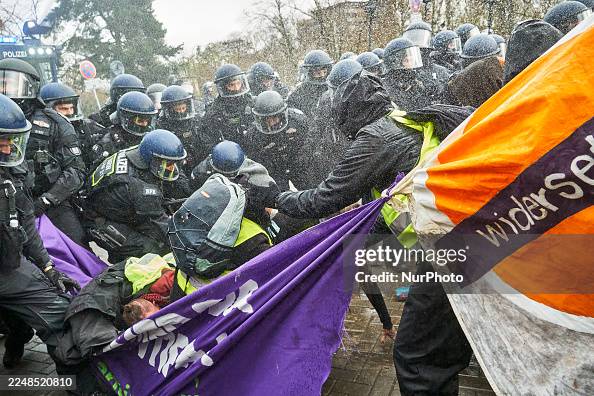
This securitized “inside” is heavily staffed. The police are on duty at the market every day; at weekends they are reinforced by police from France and Switzerland. Riot police are planned, alongside private security and the city’s enforcement officers patrolling the stalls. Weapons and knives are formally banned. The message is clear: this is a controlled zone, guarded from “dangerous others”.
And because it is Freiburg, the whole thing is, of course, proudly advertised as running on “100% green energy” – a clean, sustainable Christmas. But that “green” electricity does not fall from the sky. It depends on batteries, cables and infrastructure built from raw materials ripped out of places like Congo: cobalt, copper, lithium. Meanwhile, genocide is being funded with our taxes and our labour. The cosy glow on the Münsterplatz is plugged directly into extractivism, poisoned rivers and exploited labour elsewhere.
Barriers, police, security and green branding together draw a line through the city. Inside the bright, fenced-off area: those who can afford five-euro Glühwein, welcome as customers. At the edges of the same square: people without housing, people in poverty, people racialised as “risky” – treated as security problems, not as neighbours. They literally sit at the periphery of the Christmas market, in the shadow of a celebration that is not meant for them.
Here, Merz’s talk of the Stadtbild becomes concrete. The Christmas market, with its consumer logic and “attractive cityscape”, is what is to be praised and protected. The people at its margins – the homeless, the poor, migrants – are what is to be admonished as a “problem for the cityscape”, something that spoils the image and should be removed.
Christmas sells itself as a time of charity and warmth, but it is organized as an exclusionary space. It separates those who “deserve” comfort from those who are allowed to exist only as a disturbance or threat. Even the supposed “way out” offered within this logic is individual: if you are poor, you are told to work harder, be entrepreneurial, maybe one day open your own stand. Poverty is framed as personal failure, not as the consequence of a system that needs winners and losers.
What is missing is any idea of solidarity that breaks with this logic altogether.
We can see another practice in Sudan.

Under war, displacement, hunger and state collapse, neighbourhood resistance committees in Sudan have set up community kitchens to keep people alive. There are no cosy markets there, and no NGOs swooping in to “save” anyone. Human rights organisations and aid agencies are absent, or appear only on terms set by the same imperial states that help fuel the war – often providing just enough assistance to stabilise the situation and discourage migration towards Europe.
The community kitchens are something else entirely. They are not charity from above. They are self-organised survival: neighbours pooling what exists locally – a truck, a yard, a gas bottle, a field, cooking skills, time, labour – and turning it into shared infrastructure.
This is a radical reconceptualisation of resources. Instead of asking “Who has money?”, people ask “What do we have among us?” The return is not profit, but collective survival and strength. This model:
- mobilises local, non-financial assets,
- distributes food according to need,
- and keeps control in the hands of those who use it.
Because decisions are made collectively, it resists hegemony and co-optation. It is explicitly political: a social space where popular power is practised daily, where people defend their ability to survive and shape their future, independent of external agendas. In Sudan, this is a matter of life and death.
In Freiburg, we live in extreme privilege by comparison. People freezing on the street here are not doing so because the city has no food, no space, no money. They are freezing because of political choices: property rights enforced more harshly than the right to housing; a city centre designed for consumption and tourism, not for need; ever-growing budgets for policing and “security” while social services are cut, privatised or buried in bureaucracy.
Exactly because our situation is so privileged, there is no excuse to maintain Christmas as an exclusionary spectacle ringed by barriers, police and guards – and then wash it green with “100% renewable” branding built on extraction elsewhere.
If we take the Sudanese community kitchens as a model, an autonomous, anti-capitalist Advent in Freiburg could mean:
- Setting up solidarity kitchens at the edges of the Christmas market, serving hot food and tea to anyone who needs it – housed or unhoused, with or without papers – without pity, tests, or charity branding.
- Pooling resources – kitchens, cars, storage spaces, skills, time, some money – to build common infrastructure: food, warm clothes, sleeping bags, power banks, information.
- Treating these places not as neutral welfare, but as spaces to meet and organise: to talk about why people are homeless, policed and poor in one of the richest regions in the world – and how to change it.
The goal is not to make Christmas a bit “nicer” within capitalism. It is to practise something that stands outside its logic: a redistribution from those with more to those with less, not as charity from above but as a conscious decision from below.
The person sitting at the periphery of the Christmas market is not a blemish on the festive scenery. They are a mirror held up to the city, showing that this way of celebrating is built on exclusion, securitisation and the criminalisation of poverty – powered, quite literally, by resources extracted from somewhere else.
We cannot copy Sudan’s struggle into Freiburg, and we should not romanticise it. But we can learn from the fact that, under bombardment and hunger, people build daily structures of solidarity without waiting for states, NGOs or donors.
Here, under fairy lights, mobile “anti-terror” barriers, permanent police presence and “100% green” marketing, the question for us is simple and sharp:
If they can build community kitchens under war, why can’t we build them under Christmas?
 tadamun