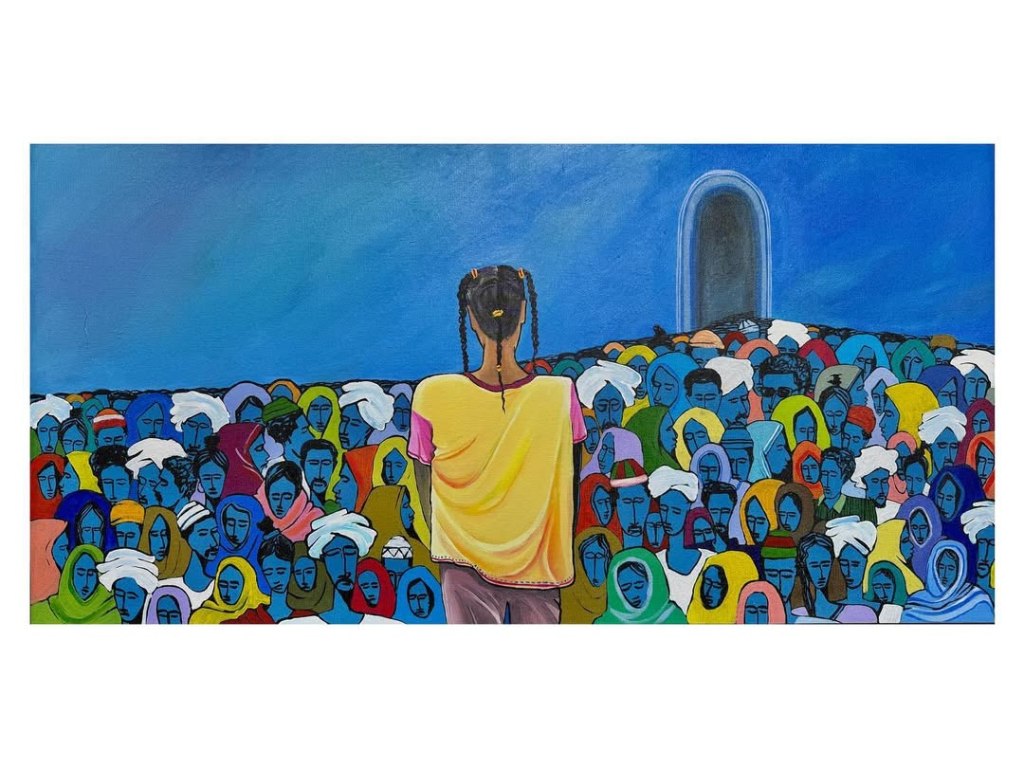
(Photo credit: @galalgoly)
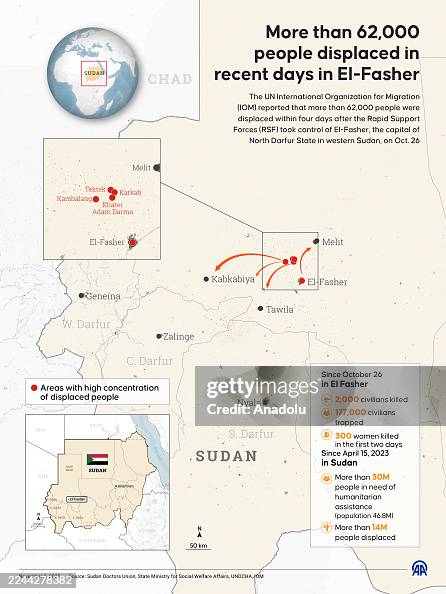
El Fasher has fallen. The last resistance gun fell silent on October 28th, 2025. This is not a „civil war“, this is an external war of aggression with multiple foreign actors supporting the Sudanese Armed Forces (SAF) or the Rapid Support Forces (RSF), with minimal concern for the safety or freedom of the people of Sudan.
And so, the people must resist.
The resistance committees of El Fasher have written on October 28th, 2025 on facebook:
Today we declare the fall of the city. In this moment, the last sound of gunfire faded when the last resisting soldier fired his final bullet at the militia inside the city of El Fasher, then fell a martyr—standing, as he was born standing, a guardian of the land he loved until his last breath.
The city fell, but its dignity did not. Bodies have vanished, but the spirit still flutters over the walls and streets, guarding what remains of memory. Every stone here testifies that its people did not surrender, and that El Fasher was not defeated but betrayed—and has paused to write a new chapter in its history.
Glory and everlasting remembrance to the martyrs.
Glory to those who stood firm to the end.
And to all who kept the pledge and stayed the course.

To the steadfast masses of our Sudanese people,
With hearts wracked by pain and filled with anger, we follow the horrific massacres committed by the Rapid Support Forces (RSF) militia against unarmed civilians in the city of El Fasher. These crimes began with systematic siege and starvation and escalated to the most extreme forms of violence: mass killings, rape, arson, looting, the destruction of places of worship, the targeting of journalists, the killing of children, women, and the wounded, the pursuit and killing of civilians fleeing the fighting, and the complete violation of the city.
This is an extension of a long path of terror and brutality that this militia has practiced against our people across Sudan. What is happening in El Fasher is a fully fledged crime of ethnic cleansing aimed at erasing human existence in Darfur. It makes clear to the world that this militia represents nothing but a project of organized killing and looting, bearing no relation to patriotism or to humanity.
Accordingly, and out of our revolutionary and humanitarian responsibility, we declare the following:
- Our total condemnation of the massacres in El Fasher and of all crimes committed by the Janjaweed militia against civilians.
- We hold the leadership of this militia fully criminally responsible for these crimes before the people and before history.
- We explicitly call on the international community, the United Nations, the African Union, and free human-rights organizations to designate the Janjaweed militia as a terrorist organization that commits war crimes and crimes against humanity.
- We demand the immediate imposition of the harshest, most deterrent sanctions on its military and political leaders, and their prosecution before international courts.
- We call for urgent humanitarian corridors to protect civilians and deliver aid to those affected in El Fasher and in besieged areas.
The blood of our people in El Fasher is a trust upon our shoulders. We will remain faithful to our martyrs until justice is achieved and the killers are held to account.
Finally, we call on all Sudanese, and all Sudanese components at home and abroad, to elevate the spirit of tolerance, to put the country’s interest above all else, and to build a broad national alignment that seeks to achieve peace in Sudan according to an internal national vision—one that does not reproduce the same problems and strives to sow the seeds of a modern, civil, democratic state.
We also call on the international and regional community to intensify efforts toward a true peace, lasting stability, and complete justice for Sudan and the Sudanese people.
We will not forget, we will not forgive, and we will not be silent.
Glory and eternal honor to the martyrs.
Freedom, peace, and justice for the entire homeland.Signatories:
- Coordination of the Resistance Committees – El Fasher
- Coordination of Al-Kalaklat and South Khartoum
- Coordination of the Resistance Committees – Karari
- Neighborhood Committees – Bahri
- Gathering of the Committees – Jabal Awliya
- Coordination of the Resistance Committees – Old Omdurman
- Ghadibun Bila Hudud (“Angry Without Borders”)
This committee has in a separate post made it clear on which side it stands:
We do not resemble any group or current that merely seeks to preserve the state and its institutions, nor do we derive our message from anyone else. We represent the voice of the homeland and strive to build a true state free of militias—a state founded on the rule of law, justice, and equal citizenship. Our message is not directed against any social group, sect, or tribe; it is a unifying national stance that rejects injustice in all its forms and stands against anyone who tries to fragment this country or steal its sovereign decision-making. We harbor no hatred toward anyone, but we hold a deep conviction that homelands are not built on narrow loyalties and tribalism, nor safeguarded by unchecked weapons.
We recognize that the militias imposing their dominance over people today represent nothing but a project of chaos, seeking only to undermine the state and weaken society. Hence our discourse is one of resistance to these forces that want to hijack the homeland and distort its meaning—a resistance through words, awareness, and principle, not through incitement or revenge.
We are hostile to no one, but we will not compromise on the homeland.
Background
Gen. Abdel Fattah al-Burhan, head of the Sudanese Armed Forces (SAF) and effectively the country’s president, is at war with his former deputy, Gen. Mohamed Hamdan “Hemedti” Dagalo, who leads the Rapid Support Forces (RSF).
The RSF was created in 2013 from Janjaweed networks and commanders, keeping much of their personnel, tactics, and local power structures.
The Janjaweed were central to the Darfur war (2003–2020) and were widely accused of genocide and ethnic cleansing against Arab and non-Arab communities. By October 2007, the United States had labeled the Darfur killings genocide, citing an estimated 200,000–400,000 civilian deaths over the prior three years.
In Darfur, the term “Janjaweed” historically meant bandits or outlaws; victims use the word „Janjaweed“ for camel- and horse-mounted raiders who attacked villages—often alongside government troops with air support.
The RSF still often gets called „Janjaweed“ by locals indicating that the relabeling of the „Janjaweed“ into RSF was done only in name.
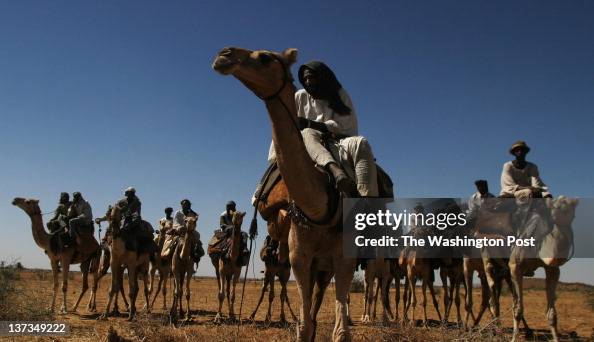
These „Janjaweed“ militias are often powerful local actors with strong incentives to defend gains in land and livestock—key economic and political assets that bring authority over those who live on and use them.
After its formation, the RSF was deployed against rebels in Darfur, South Kordofan, and Blue Nile, and today stands as the main rival to the SAF.
(references: Empty Promises, A simple guide to what is happening in Sudan)
Foreign Complicity
Several foreign powers—Iran, Russia, and the United Arab Emirates (UAE)—have fueled Sudan’s civil war by supplying drones to opposing sides for over a year. Iran has provided drones to the Sudanese Armed Forces (SAF), reportedly seeking a Red Sea naval base in return. Russia first leveraged Wagner’s ties to the Rapid Support Forces (RSF) to deliver drones and other weapons in early 2023, then switched sides in spring 2024, offering aid to the SAF in exchange for reviving a 2017 deal for a small Russian Red Sea base. Meanwhile, the UAE has backed the RSF to protect its economic and political influence in Sudan and the Red Sea through its relationship with RSF leader Mohamed Hamdan “Hemedti” Dagalo. Both warring parties have used these foreign-supplied drones to gain battlefield advantages and strengthen their hands in ceasefire talks.
(reference: Drones over Sudan: Foreign Powers in Sudan’s Civil War)
1. United Arab Emirates
The UAE has backed the RSF to secure its economic and political influence in Sudan and across the Red Sea, leveraging close ties with RSF leader Mohamed Hamdan “Hemedti” Dagalo. The UN, the United States, and other observers have accused the UAE of funding and supplying the RSF through logistics hubs in neighboring states—Central African Republic, Chad, Libya, and Uganda. In September 2024, The New York Times reported the UAE had begun using Chinese drones comparable to the U.S. MQ-9 Reaper, operating from Chad, to provide intelligence, surveillance, and reconnaissance support to the RSF.
Hemedti and the RSF built strong links with Abu Dhabi by joining UAE-aligned military coalitions in Libya and Yemen, ties that have since deepened into an economic partnership. Hemedti’s grip on Sudan’s gold sector—Dubai is the leading importer of Sudanese gold—further cements his value to the UAE. These relationships position him as Abu Dhabi’s preferred partner for a $6 billion port and agriculture project on Sudan’s Red Sea coast announced in 2022, in which Emirati firms hold a 65% profit stake—part of a wider UAE strategy to expand power through client ports along the Red Sea.
(Reference: Africa File Special Edition: External Meddling for the Red Sea Exacerbates Conflicts in the Horn of Africa)
2. Egypt
A March 2022 UN report found that many entitlements in Egypt are not effectively available to all: Sudanese and other East Africans often face discrimination and xenophobia, living in “parallel informal communities” in cities with poor access to education and healthcare. Since April 2023, the war in Sudan has displaced millions—around 25 million people now need aid. Refugees and NGOs report Egyptian security searches in neighborhoods with many Sudanese, with detentions and deportations even for people holding UNHCR cards or pending UNHCR appointments—protection that “used to mean safety” no longer does. At the same time, the EU announced in March 2024 a €7 billion package for Egypt, including at least €200 million for migration control. Critics warn that funding “migration management” while abuses persist risks implicating Brussels and EU states in rights violations.
Legal and procedural barriers deepen refugees’ vulnerability. Visas are largely unattainable for Sudanese, pushing many to enter irregularly. Asylum seekers must travel over 1,000 km to Cairo to apply, then wait eight to twelve months for UNHCR registration; to stay regular, they are supposed to obtain six-month residence permits, yet by March 2025 the wait for an appointment had reached 29 months, according to civil society groups. Without UNHCR paperwork and residence permits, refugees and asylum seekers live under constant threat of detention.
(reference: Sudanese Refugees in Egypt: “Voluntary” Returns Amidst Intensified Detention and Deportation Campaign)
3. Germany and EU
European—especially German—policy on Sudan has focused on stopping migration and keeping “stability.” Sudan is a main route from Ethiopia and Eritrea, this has meant deals were struck with strongmen instead of addressing the material reasons underpinning migration.
The result is the opposite of what Europe officially desires: hundreds of thousands are trying to migrate, often „illegally“.
Even after sanctions against Sudan, the EU (including Germany) kept some security and economic ties with Khartoum, especially on migration and counterterrorism. German involvement went beyond words: reports point to indirect arms transfers through third countries, migration-control projects that strengthened militias, and aid sent through unaccountable state bodies. Despite an arms embargo, German-made weapons (like Heckler & Koch) have been seen in Sudan via intermediaries.
The RSF was not officially hired, but still gained from EU-backed border programs such as GIZ’s Better Migration Management. EU funding effectively outsourced parts of border control to Sudan’s security forces—including the RSF—by providing surveillance tools and vehicles (Toyota Hilux and Land Cruiser). These were meant for borders but were later used to crush protests, including the June 2019 Khartoum sit-in massacre (at least 186 killed).
(Reference: From Darfur to Khartoum: How Germany’s migration policies fuelled Sudan’s war machine)
Documentation
(https://sudan-genocide.org/index.php)
A website was founded to be a platform for documenting the RSF militias violations, and to witness what innocents have been up to from killing, displacing and violating. It also contains a comprehensive record of victims, survivors and missing, and a search engine enables families to find their relatives who have arrived in safe and secure areas.
Demonstration
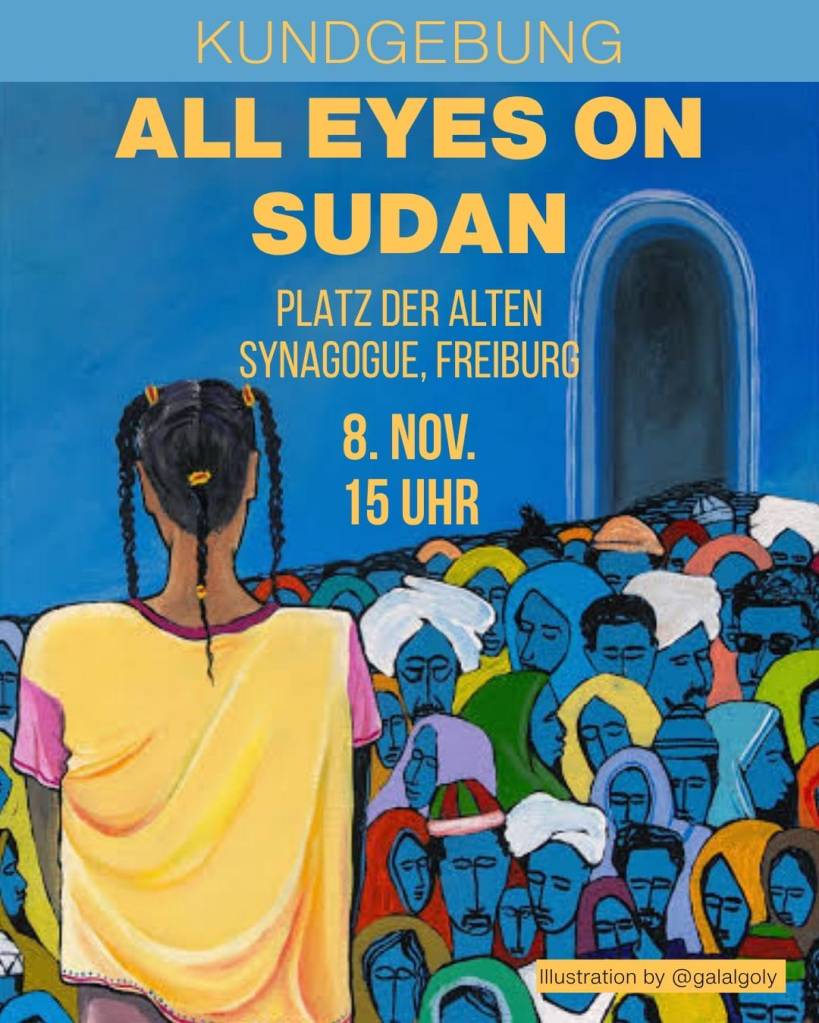
Sudanese society has overthrown military regimes three times—1964, 1985, and 2019—through broad, popular mobilization. This history sustains today’s civilian rejection of military rule and offers a basis for political renewal, even amid the destruction in Sudan.
The setback in El Fasher is only one battle in the Sudanese people’s path to dignity, justice, and freedom. We stand in solidarity with the people of Sudan against all who threaten their dignity and self-determination. Sudan will rise. We honor the people’s resolve.
 tadamun