
This article is a review of the book by J.K. Gibson-Graham, The End of Capitalism (as We Knew It): A Feminist Critique of Political Economy.
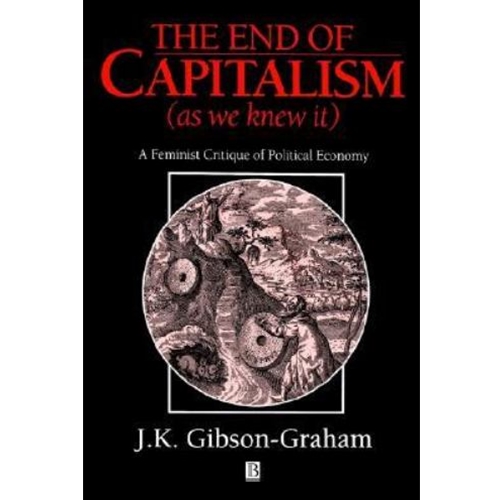
J.K. Gibson-Graham challenges the idea that capitalism is the system that defines the whole economy. The book asks why anger at capitalism so rarely turns into projects that build real alternatives, and it argues that some common ways of talking about capitalism can block that work by making it seem all-encompassing.
Across the book, she takes up several topics: how we name and picture “the economy,” how we think about work and value beyond wage labor, how class can be understood through exploitation and where surplus goes, how firms gather and disperse wealth, how stories about globalization and development are told, how policy talk uses body metaphors, and how ideas like Fordism and post-Fordism shape economic strategy. The aim is to make room to see economic difference in the present, and to treat alternative practices as real and buildable rather than marginal.
Capitalism
When capitalism is taken to be total, every activity is read as capitalist or as serving capitalism. Care, household labor, informal exchange, mutual aid, commons practices, cooperatives, subsistence work, and community provisioning get recoded as “reproduction of capitalism” or as marginal leftovers. The book treats that as discursive violence because it makes real practices conceptually disappear. It also makes them harder to defend, expand, or transform because they are not recognized as economic.
This matters because the “formal economy” is only a slice of livelihood-making. Wage labor, markets, and capitalist firms do not exhaust how people survive. Even in wealthy countries, large parts of life are organized through nonmarket and nonwage relations. Indeed, the bottom two-thirds of the table below accounts for well over half of economic activity. The book’s point is not a precise percentage claim but the political implication: calling whole societies “capitalist” flattens a mixed field into one hegemonic identity.
| MARKET | WAGE | CAPITALIST |
| Alternative Market Sale of public goods Ethical „fair-trade“ markets Local trading systems Alternative currencies Underground market Co-op exchange Barter Informal market | Alternative Wage Self-employed Cooperative Indentured Reciprocal labor In-kind Work for welfare | Alternative Capitalist State enterprise Green capitalist Socially responsible firm Nonprofit |
| Nonmarket Household flows Gift giving Indigenous exchange State allocations State appropriations Gleaning Hunting, fishing, gathering Theft, poaching | Unpaid Housework Family care Neighborhood work Volunteer Self-provisioning labor Slave labor | Noncapitalist Communal Independent Feudal Slave |
What is wrong with much leftist discourse on capitalism, in this critique, is not the focus on exploitation. It is the way capitalism becomes an essence. How class flattens other social relations, and the subordination of race and gender to class.
- Definitions of capitalism that force totalization treat it as the system that structures the whole social formation. Other relations become secondary, derivative, or “really capitalist underneath.” Racism, for example, gets framed as a tool that divides workers and weakens class struggle, instead of as a relation with its own logics, histories, and material effects.
- Household labor is pushed into a secondary status. It gets framed as “reproduction” that supports real work, rather than as a site of production, appropriation, and distribution of surplus labor with its own struggles and stakes. Household relations are flattened into capitalist relations, so domestic power, dependence, and conflict are treated as effects of wage labor and markets instead of relations that also shape economic life.
- A politics that becomes all-or-nothing. If the system is treated as total, then resistance that does not aim at rupture looks like accommodation. Local transformation looks irrelevant. Even left politics can be read as reproducing capitalism whenever it falls short of “revolution,” which narrows the discursive space for change.
- Economic essentialism turns class into a master structure. Capitalist class relations become the central and “real” layer of society, while race, gender, disability, law, and sexuality are treated as secondary or “ideological.” This produces a discursive hegemony of capitalist class relations, where other struggles must be translated into class terms to count as political. In that frame, racialized people are expected to adopt “class consciousness,” set aside their own conflicts, and fold into a single class struggle defined elsewhere.
- Interests and consciousness get essentialized. Workers are assumed to have a unified “true” interest and a predictable political role. Deviations get explained as false consciousness from a „historical mission“.
How the book rethinks this discourse starts from two positions.
First, it takes seriously that people occupy multiple class positions at once. A person can be exploited as a wage worker, appropriate surplus in a household, receive dividends as a shareholder, and self-appropriate surplus as a self-employed producer. Once you see this, the idea of one “true” class interest becomes hard to sustain.
Second, it insists that economies are mixed. Noncapitalist class processes exist alongside capitalist ones in the same places. So people also occupy contradictory positions across noncapitalist processes, not only “within capitalism.”
Overdetermination is the method that supports this. It means no process has a single core cause. Any class process is constituted by many other processes, law, culture, race, gender, state power, technology, ecology, and it also helps constitute them. Class has no privileged explanatory position, but it is not reduced to other categories either.
Class as a process is the second support. Class is defined as the production, appropriation, and distribution of surplus labor. This shifts class analysis away from sorting people into rigid groups and toward mapping who produces surplus, who takes it, and where it goes in each site.
Within this frame, capitalism becomes one specific class process. It is the process in which nonproducers appropriate surplus labor in value form from free wage laborers, and then distribute that surplus to various destinations. Capitalism is a scattered set of practices across workplaces and institutions that interacts with many noncapitalist practices and with nonclass processes.
By defining political subjects through economic positions and interests set by what Gibson-Graham calls a “closed economic mechanism that constituted capitalism,” leftist politics can become bound to the object it wants to undo. Strategy narrows to identifying the mechanism, opposing it, and waiting for the “revolutionary moment,” while other forms of transformation are treated as secondary.
Gibson-Graham’s alternative is the community economy, understood as an ethical and political space. It is not grounded in a set blueprint for how to “be communal.” It is built through practice, negotiation, and struggle, with uncertainty, ambivalence, and disappointment as part of the work. The starting point is that we are already implicated in each other’s lives, so the task is to make and remake economic relations through deliberate choices about responsibility, connection, and the organization of collective life.
Patriarchy
Gibson-Graham does not define patriarchy as an autonomous system with its own laws. She also does not reduce it to a simple effect of capitalism. Instead, gender domination is understood as overdetermined. Patriarchal relations in the household are constituted through class processes, cultural norms, legal arrangements, racial regimes, and state policies, and they in turn shape those processes. There is no single cause.
The book rejects the notion that women “inherit” class position or economic status through husbands or fathers. Women are treated as subjects whose labor and decisions actively shape economic relations, by recognizing that the household as a site of production, appropriation, and distribution of surplus labor.
Some man–woman relations structured by dependence are analyzed as feudal class processes, where surplus labor is appropriated within the household. Feminist struggles then appear not as demands for inclusion into capitalism, but as class struggles within the household, aimed at transforming feudal relations into more communal ones.
Gibson-Graham’s treatment of patriarchy avoids economic determinism. Patriarchy is neither a base structure nor a secondary “ideological” layer. It is one set of relations among many that shape and get shaped by the economy. Feminist politics, in this view, is not derivative of class politics. It is a site where class processes themselves can be transformed.
Verdict
By describing noncapitalist practices, the book makes them visible in a field where capitalism is treated as the hegemonic reality. This is particularly important for our work in Tadamun, where reading the book makes clear that what we are building is not only activism but can be understood as participation in the noncapitalist part of the economy itself.
Gibson-Graham’s use of “hegemony” is as a simple model of domination, where capitalism suppresses difference, where alternatives appear once that suppression is unsettled. A different view of hegemony suggests that capitalism does not rule by suppressing difference alone, but by managing and organizing it. In this view, alternatives can exist within hegemonic rule and be produced and sustained in ways that support a wider economic order. Capital’s strength then lies in its capacity to organize difference rather than to eliminate it.
Kalyan Sanyal’s Rethinking Capitalist Development follows this objection. He asks whether capitalist development generates and sustains a mixed field of capitalist and noncapitalist production within the same space. If so, noncapitalisms do not mark an outside. They can be part of how capitalism reproduces itself through differentiation, by organizing a landscape of varied forms that remain tied to commodities and markets.
The End of Capitalism is highly recommended for the way it engages critically and instructively across a wide range of theory, from Marx and Engels, Althusser, Resnick and Wolff, Foucault, and Derrida, to feminist writers such as Donna Haraway, Judith Butler, and Elizabeth Grosz.
Get the book here: https://www.amazon.com/End-Capitalism-As-Knew-Political/dp/0816648050 *
*We do not advocate to using Amazon, so if you find the book on another platform, please write us.
 tadamun
Hinterlasse einen Kommentar